

Waking up to a power outage is inconvenient. For CPAP users, it can be a serious health concern, disrupting essential therapy. You need a backup plan that delivers more than just electricity, it must provide clean, stable power sensitive to medical equipment.
This guide focuses on generators under 3000 watts specifically suitable for powering CPAP machines and other critical home devices. We have assessed key models that balance output, fuel flexibility, and quiet operation to keep you comfortable and connected. For a broader look at backup solutions, explore our guide on top emergency generators under 3000 watts.

Pros
- Three fuel options provide maximum flexibility and ensure you can always find available fuel during emergencies
- Exceptional runtime of up to 16 hours means less frequent refueling during extended power outages
- Low THD technology and copper windings produce clean, stable power safe for sensitive equipment
- Transfer switch ready design allows professional installation for automatic home backup capability
- Comprehensive outlet selection including two 50A/30A heavy-duty outlets plus standard household outlets
Cons
- Heavy at 348 pounds requires significant space and sturdy ground placement for safe operation
- Higher initial investment compared to single-fuel generators limits budget-conscious buyers
- Tri-fuel setup adds complexity compared to standard gas-only models, requiring more maintenance knowledge
The Westinghouse WGen14500TFc is a heavy-duty tri-fuel portable generator designed for homeowners seeking comprehensive backup power for larger residences and contractors requiring flexible fuel options on job sites. With 18,000 peak watts and 14,500 running watts on gasoline, this generator bridges the gap between portable convenience and stationary backup power capacity.
What sets this model apart is its exceptional tri-fuel capability and impressive 16-hour runtime on a 10.5-gallon tank at 25% load. The V-Twin OHV engine with cast iron sleeves delivers consistent performance across fuel types, while copper windings and sub-5% THD output ensure safe operation of computers, TVs, and other sensitive electronics. The included remote start and push-button ignition make operation effortless, and the digital VFT data center provides real-time voltage and maintenance tracking.
Build quality is robust with reinforced steel handles, lift bar, and never-flat wheels for mobility. The comprehensive outlet configuration includes two transfer switch-ready outlets (14-50R 50A and L14-30R 30A) plus standard household outlets, USB ports, and GFCI protection. The automatic low oil shutdown and CO sensor add critical safety features for peace of mind during extended use.
The primary consideration is weight at 348 pounds, which requires careful placement and secure positioning. Additionally, the tri-fuel complexity demands more maintenance knowledge than single-fuel models. The higher price point reflects the advanced engineering and fuel flexibility, making it an investment rather than a budget option.
For homeowners with larger properties or contractors needing reliable, multi-fuel backup power, the WGen14500TFc delivers exceptional performance and flexibility. The combination of clean power output, extended runtime, transfer switch readiness, and tri-fuel capability makes this a premium choice for serious backup power needs backed by Westinghouse's three-year warranty and nationwide service network.
Power Output: 18,000 peak watts (gas), 14,500 running watts (gas), 16,000 peak watts (propane), 13,000 running watts (propane), 14,400 peak watts (natural gas), 11,600 running watts (natural gas)
Engine: 713cc Westinghouse V-Twin 4-Stroke OHV with cast iron sleeve, automatic low oil shutdown, and low idle mode
Fuel Tank: 10.57 gallons with automatic fuel gauge
Runtime: Up to 16 hours at 25% load on gasoline
Outlets: One 120/240V 14-50R 50A outlet (transfer switch ready), one 120/240V L14-30R 30A outlet (transfer switch ready), one 120V L5-30R 30A outlet, two GFCI 120V 5-20R 20A duplex outlets, two USB ports
Power Quality: Less than 5% THD, automatic voltage regulation, copper windings
Starting: Push button electric start and remote key fob start
Noise Level: 74 dBA operating volume
Dimensions: 30.3 inches L x 34.9 inches W x 34.3 inches H
Weight: 348.3 pounds
Warranty: 3-year limited warranty with lifetime technical support
Included Accessories: Engine oil, funnel, assembly wrench, battery charger, propane hose, cover, quick-start guide, owner's manual, and replacement parts list
Who Should Buy This Generator? The WGen14500TFc is ideal for homeowners with larger properties who want reliable whole-home backup power, contractors needing flexible fuel options on job sites, and users who prioritize clean power for sensitive electronics. If you have central air conditioning, multiple refrigerators, sump pumps, or extensive entertainment systems, this generator's 14,500 running watts can handle simultaneous operation.
Transfer Switch Integration: Both heavy-duty outlets are transfer switch and interlock kit ready, meaning a licensed electrician can professionally install this generator for automatic power transfer during outages. This setup eliminates manual cord management and provides seamless backup power to your entire home.
Fuel Flexibility Advantages: The tri-fuel capability means you can run the generator on whichever fuel is most available or economical. During natural disasters, propane and natural gas often remain available when gasoline supplies are depleted. This flexibility adds significant value for long-term reliability.
Maintenance Considerations: Tri-fuel generators require more maintenance knowledge than single-fuel models. You'll need to understand fuel switching procedures, proper carburetor management, and seasonal storage protocols. Westinghouse's lifetime technical support can help guide you through these processes.
Space and Weight: At 348 pounds, this generator requires a permanent or semi-permanent location. Ensure you have level, well-ventilated ground space away from windows and doors. The never-flat wheels and lift bar assist with initial placement, but this isn't a portable unit you'll move frequently.
Investment Value: The higher price reflects advanced engineering, tri-fuel capability, and transfer switch readiness. If you need basic portable power for occasional use, a smaller single-fuel generator may suffice. If you prioritize reliability, fuel flexibility, and whole-home backup capability, this investment delivers substantial long-term value.
Pros
- Tri-fuel capability provides unmatched flexibility, allowing you to choose the most economical or available fuel source for any situation
- Exceptionally quiet at 64 decibels, making it suitable for residential neighborhoods and camping without disturbing others
- Pure sine wave technology protects expensive electronics and enables safe operation of sensitive equipment
- Comprehensive outlet configuration includes dual voltage switching, USB ports, 12V DC outlet, and EV-ready NEMA 14-50R receptacle
- Built-in safety features like automatic CO shutdown, low-oil cutoff, and overload protection provide peace of mind
Cons
- Cannot simultaneously use 120V and 240V outlets due to voltage selector switch design, limiting multi-voltage applications
- Heavy at 246.9 pounds and requires significant space, making storage and transport challenging for smaller properties
- Propane runtime is limited to approximately 3 hours on a 20-pound tank compared to 7.7 hours on gasoline
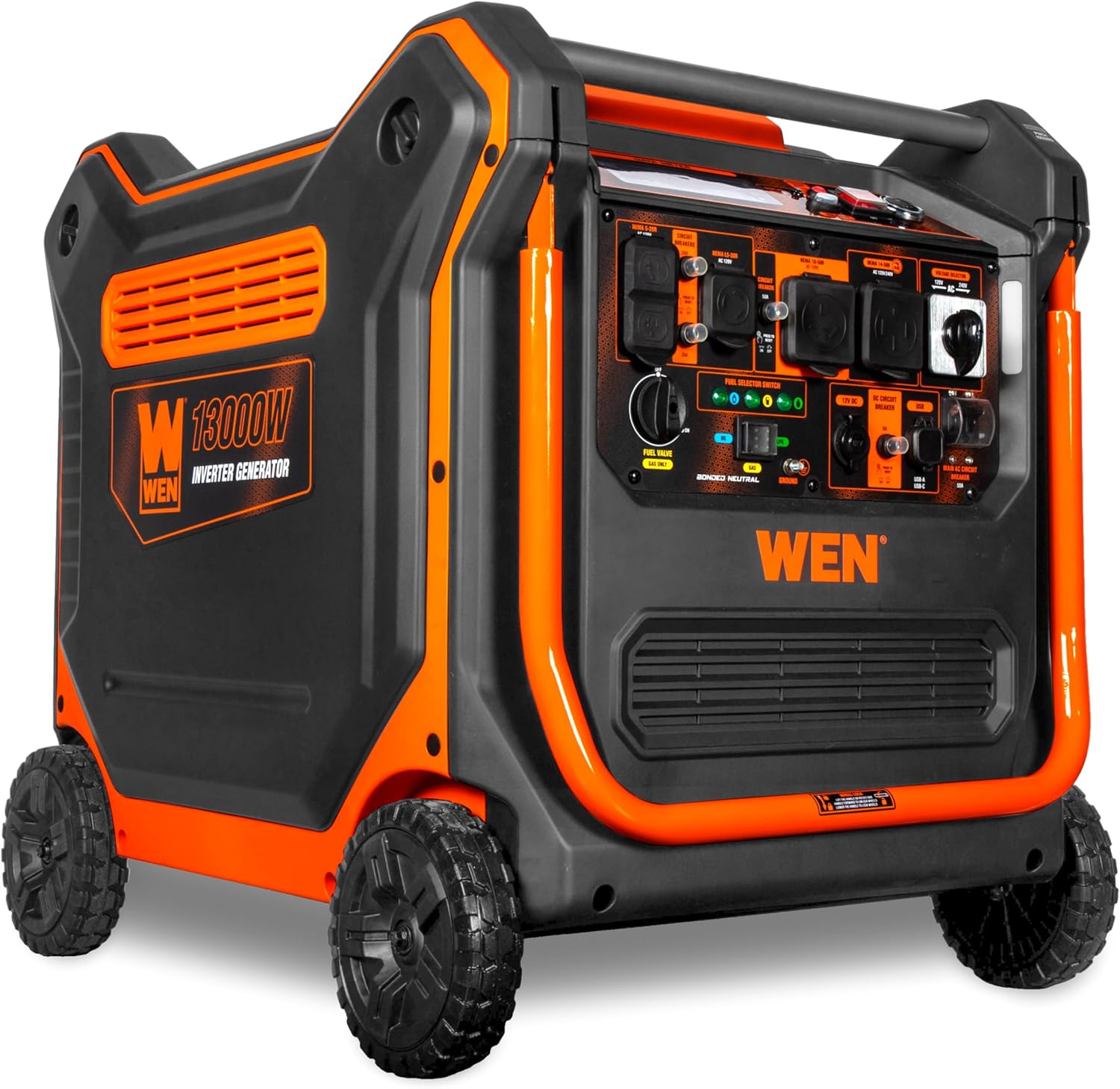
The WEN TF1300iX is a premium tri-fuel inverter generator designed for homeowners, small business operators, and outdoor enthusiasts who need reliable backup power with maximum flexibility. This 13,000-watt powerhouse runs on gasoline, propane, or natural gas, allowing users to select the most practical fuel source for their situation. Whether you're preparing for emergencies, powering job sites, or camping off-grid, this generator adapts to your needs.
The standout feature is its exceptional quiet operation at just 64 decibels at quarter load, combined with impressive power output of 10,500 running watts on gasoline. The electric start button eliminates the frustration of pull-cord starting, though a backup pull-cord is available if needed. Pure sine wave technology maintains harmonic distortion under 1.2% at full load, making it safe for laptops, smartphones, medical equipment, and other sensitive electronics. The eco-mode throttle automatically adjusts engine speed based on demand, maximizing fuel efficiency and extending runtime significantly.
Build quality is evident throughout, with a well-designed control panel featuring eight power outlets including a 120V/240V NEMA 14-50R receptacle ready for transfer switches or Level 2 EV charging. The comprehensive outlet selection includes USB ports, 12V DC output, and multiple voltage configurations. The 550cc 4-stroke engine is robust and reliable, backed by WEN's three-year limited warranty and nationwide service network. The 7.1-gallon fuel tank delivers up to 7.7 hours of half-load runtime on gasoline.
One significant limitation is the voltage selector design, which prevents simultaneous use of 120V and 240V outlets. If you need to run both voltage types concurrently, this generator won't accommodate that requirement. Additionally, at 246.9 pounds and measuring 32.3 inches long, it's a substantial machine requiring dedicated storage space. The included wheel kit and folding handle help with transport, but it's not truly portable for frequent relocation.
The WEN TF1300iX represents excellent value for serious backup power needs. It's ideal for homeowners wanting emergency preparedness, RV owners seeking reliable campground power, and small business operators needing job-site electricity. The tri-fuel capability, quiet operation, and advanced safety features including automatic CO shutdown make this generator a smart investment for long-term power security.
The tri-fuel capability is this generator's defining advantage, offering three distinct power and runtime scenarios. On gasoline, you get maximum output with 13,000 surge watts and 10,500 running watts, plus the longest runtime at 7.7 hours on half load with the 7.1-gallon tank. Gasoline is ideal for emergency backup and maximum power demands.
Propane offers a middle-ground option with 11,250 surge watts and 9,000 running watts. Using the included LPG quick-connect adapter and six-foot hose, a standard 20-pound propane tank provides approximately 3 hours of half-load runtime. Propane is cleaner burning, stores longer without degradation, and is widely available at hardware stores and gas stations.
Natural gas provides the longest-term solution for stationary installations, delivering 10,000 surge watts and 8,000 running watts. While runtime depends on your gas line pressure and flow rate, natural gas offers unlimited fuel supply when connected to your home or facility's gas line. The NG hose is sold separately, but this option eliminates fuel storage concerns entirely.
The WEN Watchdog CO Shutdown Sensor is a critical safety feature that automatically turns off the generator if carbon monoxide levels become dangerous. This is especially important for emergency backup situations where the generator might be used near living spaces. Never operate any fuel-powered generator indoors or in enclosed spaces, but this sensor provides an additional layer of protection.
Additional safety systems include automatic low-oil shutdown that prevents engine damage from inadequate lubrication, and low-fuel automatic shutdown that prevents the engine from running dry. Built-in overload protection safeguards both the generator and connected equipment from electrical damage. Indicator lights provide clear status feedback for oil level, fuel level, and overload conditions.
The fuel shutoff feature automatically engages when the engine stops, allowing remaining fuel in the carburetor to be consumed before shutdown. This prevents stagnant fuel buildup and carburetor blockages, extending the generator's lifespan and reducing maintenance requirements significantly.
Buying Guide
Clean Power Output (Low THD)
CPAP machines and their humidifiers contain delicate electronic circuitry. They require clean power with low Total Harmonic Distortion (THD) to operate safely and avoid damage.
Look for inverter technology or generators specifically rated with a THD below 5%. This ensures a smooth sine wave, similar to utility power, protecting your investment. Our review of generators for sensitive electronics delves deeper into this critical feature.
Noise Level and Operation
Since you will likely run the generator overnight near your home, operational volume is paramount. A loud generator can disturb your sleep and annoy neighbors.
Manufacturers list noise in decibels (dBA). Aim for models with a low dBA rating, especially those featuring ‘quiet’ or ‘low idle’ modes. This makes for a more peaceful environment during extended use.
Fuel Type and Runtime
Fuel flexibility adds significant convenience and preparedness. Tri-fuel generators that run on gasoline, propane, and natural gas offer options based on availability and storage.
Consider the runtime at 25% or 50% load, which is typical for a CPAP setup. A longer runtime means fewer refueling interruptions through the night, which is crucial for consistent therapy. You can find models suited for extended operation in various conditions on our under 3000 watts category page.
Portability and Outlet Configuration
While not always moved far, a generator needs to be manageable. Features like wheel kits and fold-down handles greatly improve maneuverability on your property.
Verify the unit has the appropriate outlets. You will need standard 120V household outlets for your CPAP. Additional outlets are a bonus for charging phones or running a small light. For scenarios like cold weather camping or cabin use, a robust outlet panel adds versatility.
Final Thoughts
Selecting the right backup power for your CPAP machine is a decision that impacts your health and comfort. For users seeking maximum power and home backup capability, the Westinghouse 18000 Peak Watt Tri-Fuel Home Backup is a formidable choice. If your priority leans towards quieter inverter technology and a slightly more compact footprint, the WEN 13,000-Watt 120V/240V Tri-Fuel Inverter offers excellent clean power in a user-friendly package. Both provide the fuel flexibility and reliable output needed for peace of mind.
Frequently Asked Questions
Can I plug my CPAP machine directly into a generator?
Yes, but it is crucial to use a generator that produces clean, stable power with low Total Harmonic Distortion (THD). Using a generator with high THD can damage the sensitive electronics in your CPAP machine and its humidifier. Always consult your CPAP manufacturer’s guidelines.
How many watts does a CPAP machine need to run?
A typical CPAP machine without a heated humidifier uses between 30 to 60 watts. Adding a heated humidifier can increase the draw to 90 watts or more. It is wise to choose a generator with a running wattage that comfortably exceeds this total, allowing for additional small devices.
What is the advantage of a tri-fuel generator for CPAP backup?
Tri-fuel capability offers unmatched flexibility and preparedness. You can use readily available gasoline, store propane long-term, or connect to a permanent natural gas line. This ensures you are likely to have a fuel source available during an extended outage in 2026, keeping your therapy uninterrupted.
Are inverter generators better for medical equipment?
Generally, yes. Inverter generators are engineered to produce very clean power with extremely low THD, making them inherently safe for laptops, phones, and medical devices like CPAP machines. They also tend to operate more quietly and adjust their engine speed to match the load, improving fuel efficiency.


Write Your Review
No reviews yet. Be the first to share your experience!