

You’ve invested in an EcoFlow solar generator for reliable, portable power. Now, you need to position your solar panels perfectly to catch every ray of sunshine. That’s where the right extension cables become essential. They bridge the gap between your panels and your power station, unlocking flexibility for RV trips, off-grid cabins, or backyard setups. This guide cuts through the clutter to review two of the highest-rated options for extending your EcoFlow system’s reach.
Choosing the correct cable isn’t just about length. It’s about ensuring safety, maintaining efficiency, and guaranteeing a reliable connection in all conditions. We’ve assessed key models based on build quality, connector compatibility, and real-world performance. Whether you’re a seasoned camper or preparing your home for emergencies, the right cable makes all the difference. For a comprehensive look at EcoFlow products, explore our EcoFlow brand hub.
Pros
- Protective woven sheath keeps cables organized and prevents tangling during storage and deployment
- Sturdy MC4 connectors deliver secure, zero-power-loss connections even at full 30-foot extension
- Included dust caps maintain connector cleanliness for systems that aren't permanently mounted
- Exceptional build quality and materials justify repeat purchases for expanding solar arrays
- Works seamlessly with boondocking setups and auxiliary panel configurations
Cons
- Cable has some stiffness due to protective sleeving, which may require careful handling during initial setup
- Requires verification of system compatibility before purchase to ensure proper connector fit
- Limited to 30-foot length, so multiple cables may be needed for larger installations
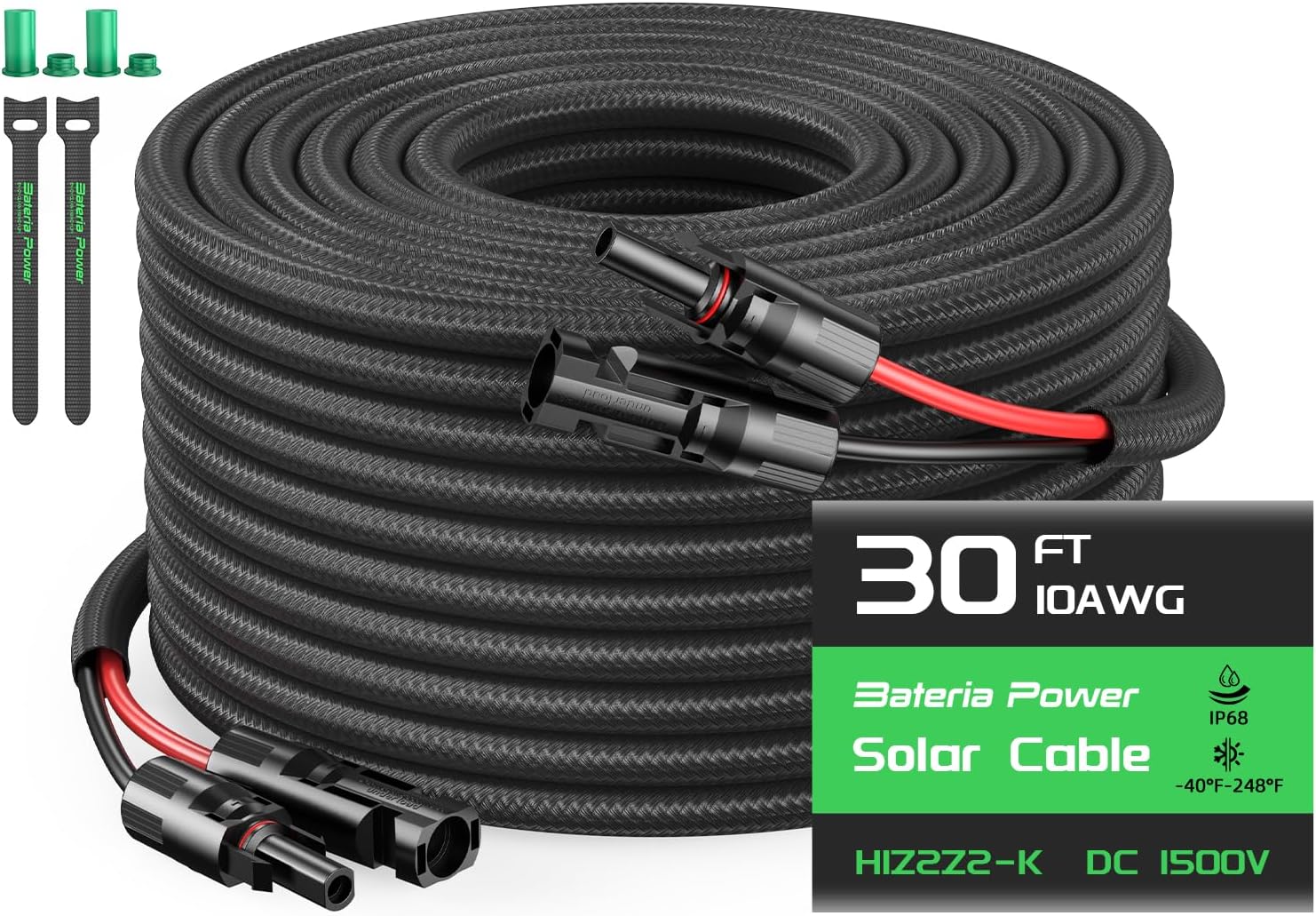
The BateriaPower 10AWG 30FT Solar Extension Cable is a professional-grade connection solution designed for homeowners, RV enthusiasts, and off-grid solar users who need reliable power transmission between solar panels and charge controllers or inverters. This cable bridges the gap between stationary and portable solar setups, making it essential for anyone expanding their solar capacity or repositioning panels seasonally.
What sets this cable apart is its combination of protective engineering and real-world durability. The flame-retardant woven sleeving isn't just a marketing feature, it actively prevents tangling and protects against physical damage from dragging and environmental wear. The TÜV-certified XLPO insulation and jacket provide genuine flame resistance and UV protection, while the extreme temperature rating (-40F to 248F) means this cable performs equally well in freezing winters and scorching summers. Users consistently report zero power loss across the full 30-foot length, a critical advantage for maximizing solar efficiency.
The build quality reflects professional solar standards. The IP68 waterproof MC4 connectors are robust and toolless, eliminating the need for specialized crimping equipment. The included dust caps are a thoughtful addition that keeps connectors clean and dry during storage, particularly valuable for systems that aren't permanently installed. The 1500V rating and 54A capacity support high-performance arrays without compromise.
The main consideration is that the protective sleeving makes the cable somewhat stiff compared to standard solar cables, though users attribute this to the added protection rather than a deficiency. The 30-foot length works well for most setups but may require multiple cables for larger installations. Always verify MC4 connector compatibility with your specific system before ordering.
This is a cable built to last through years of outdoor exposure and frequent repositioning. The repeat purchase rate among users expanding their solar systems speaks to genuine satisfaction and reliability. Highly recommended for anyone serious about solar energy independence.
Cable Specifications: 10AWG gauge, 30 feet length, black and red dual-wire configuration with woven protective sleeving.
Electrical Performance: Maximum voltage 1500V, maximum current 54A, 4-pin MC4 connector configuration (male-to-female).
Temperature & Environmental: Operating range -40F to 248F (-40C to 120C), flame-retardant, UV-resistant, weatherproof, suitable for outdoor use year-round.
Certifications: TÜV-approved, UL-listed, meets international safety standards for solar installations.
Connectors: IP68 waterproof rating, toolless MC4 design, includes protective dust caps.
Weight: 1.74 kg per unit. Warranty: 1 year manufacturer coverage.
Is This Cable Right for You? This cable is ideal if you're connecting solar panels to a charge controller or inverter at distances up to 30 feet, especially in outdoor or RV installations where durability matters. It's perfect for boondocking, auxiliary solar setups, and home installations where weather resistance is non-negotiable.
Compatibility Check: Verify your system uses MC4 connectors before purchasing. This cable works with major solar brands and universal systems, but confirm your specific inverter and charge controller specifications match the 1500V and 54A ratings.
Installation Tips: The woven sleeving makes initial routing slightly stiffer than molded cables, but this provides superior protection. Use the included dust caps when disconnecting for storage. For permanent installations, consider cable management solutions to minimize kinks in the protective sleeving.
Expansion Planning: Many users purchase multiple cables as their solar arrays grow. The consistent quality makes this a reliable choice for scaling up your system incrementally.

Buying Guide: How to Choose the Right EcoFlow Solar Extension Cable
Gauge and Cable Quality
The wire gauge, indicated by the AWG number, is critical for efficiency. A lower AWG number means thicker wires. For most EcoFlow setups with panels up to 400 watts, a 10AWG cable like those reviewed here offers an excellent balance. It minimizes voltage drop over distance, ensuring more of the solar energy your panels collect actually reaches your power station.
Look for cables made with oxygen-free copper for superior conductivity. High-quality insulation, such as XLPO or XLPE, is non-negotiable. It provides UV resistance, flame retardancy, and the ability to withstand extreme temperatures. This ensures your cable won’t degrade in the sun or crack in the cold, offering long-term reliability for your investment.
Connector Type and Compatibility
This is the most crucial compatibility check. Most EcoFlow solar generators use proprietary connectors that require an adapter or a cable with a specific end. Some cables offer universal MC4 connectors on the panel end, which are industry-standard, and an XT60 or XT60i connector on the power station end. Always verify your specific EcoFlow model’s input port before purchasing.
The XT60i connector, featured in one of our picks, represents an upgrade. It includes a smart signal pin for reverse polarity protection, automatically safeguarding your equipment. Gold-plated contacts within the connectors reduce resistance and prevent corrosion. Ensuring a perfect match prevents frustration and potential damage. For more on extending your EcoFlow system, check our guide on EcoFlow generator extension cords.
Durability and Weather Resistance
Your solar cables live outdoors. They must endure sun, rain, wind, and possibly snow. Key ratings to look for include IP68 for waterproof and dustproof performance. A high-quality protective outer sleeve, often made of materials like flame-retardant PVC, adds crucial abrasion resistance against dragging on rough surfaces.
The cable should be rated for a wide temperature range, typically from -40°F to over 200°F. This guarantees it won’t become brittle in winter or soften and degrade in summer heat. Features like included dust caps for unused connectors further protect the terminals from the elements when not in use, extending the overall lifespan of your setup.
Length and Application
Choose a length that gives you flexibility without unnecessary bulk or efficiency loss. A 30-foot cable, like both options we reviewed, is a versatile choice for many applications. It allows you to place panels in a sunny spot away from your RV’s shade or run wiring from a roof to a ground-based power station with ease.
Consider your primary use case. For RV camping, you might need enough length to route cables from the roof. For home backup systems, you may need to cover distance from your yard to a garage. Remember, longer cables can increase voltage drop, so pairing the right gauge with your required length is essential. For ideas on complete portable systems, see our review of the best EcoFlow portable generators.
Final Thoughts
Selecting the best EcoFlow solar panel extension cable ultimately depends on your specific generator model and setup needs. For a robust, universally compatible cable with exceptional protective sleeving, the Bateria Power 10AWG 30FT Solar Panel Extension is a superb all-around choice. If your EcoFlow unit utilizes or can benefit from the advanced XT60i connector with its smart protection features, the Vansdon Solar to XT60i Extension Cable 10AWG 30FT offers a future-proof and highly efficient connection. Both will reliably extend your solar harvesting capabilities for years to come.
Frequently Asked Questions
What is the difference between XT60 and XT60i connectors?
The XT60i is an upgraded version of the standard XT60 connector. It includes an additional signal pin that enables smart features like reverse polarity protection. When incorrectly connected, the XT60i can automatically cut power to prevent damage to your solar generator or panels. It also often has a higher continuous current rating and more durable construction, making it a safer and more robust choice for modern high-output solar setups.
Can I use any 10AWG solar cable with my EcoFlow power station?
Not directly. The wire gauge (10AWG) is about the cable’s capacity and is generally compatible. However, the connector on the end that plugs into your EcoFlow unit is the critical factor. EcoFlow often uses proprietary connectors. You typically need a cable that has the correct MC4 or other connector for your solar panels on one end and either a specific EcoFlow adapter or a compatible connector like an XT60i on the other end. Always check your power station’s manual for the exact input port specification before buying any cable.
How long can a solar extension cable be before I lose power?
Power loss, or voltage drop, increases with cable length and decreases with cable thickness (lower AWG number). For a typical 400-watt solar panel setup using a high-quality 10AWG cable, a 30-foot run is very efficient with minimal loss. If you need much longer runs, say 50 feet or more, you might consider stepping up to a thicker 8AWG cable to maintain efficiency. Using the appropriate gauge for your system’s wattage and desired length is key to maximizing energy harvest. For high-wattage panel setups, our resource on best EcoFlow 400w solar panels offers related insights.
Are these cables safe to leave outside permanently?
The cables reviewed here are designed for permanent outdoor use with features like IP68 waterproof ratings, UV-resistant insulation, and extreme temperature tolerance. However, best practice involves securing them properly to prevent physical damage from abrasion or tripping hazards. Using cable clips or conduits in high-traffic areas and ensuring connectors are fully mated and covered when in use will extend their life. Their materials are validated to withstand years of sun, rain, and seasonal changes, making them suitable for fixed installations.


Write Your Review
No reviews yet. Be the first to share your experience!