

The lights flicker and go dark. The hum of your refrigerator falls silent. In an emergency, a prolonged power outage isn’t just an inconvenience; it’s a threat to your safety, comfort, and property. For those seeking reliable backup power without a massive investment, the market offers robust solutions under $3000. This guide is designed for homeowners and preparedness-minded individuals who need a dependable power source that can handle essential appliances, medical devices, and family needs during a crisis.
We have assessed eight leading models that deliver significant power, versatility, and peace of mind within this budget. From traditional fuel-powered generators to advanced solar-powered stations, you’ll find options suited for whole-home backup, quiet operation, and flexible fuel sources. For more insights on preparing for specific severe weather, our guide on the best generators for hurricanes offers targeted advice.

Pros
- Tri-fuel capability provides unmatched flexibility to switch between gas, propane, and natural gas based on availability
- Inverter technology produces stable, clean power with THD under 5%, protecting expensive electronics
- Dual-start system with remote key fob makes operation convenient and battery maintainer ensures reliability
- Heavy-duty 459cc OHV engine delivers consistent performance with 5-year warranty exceeding industry standards
- Quieter operation at under 61 dB makes it suitable for residential neighborhoods and camping
Cons
- Weighs 216 pounds, requiring significant effort to move without a dolly or assistance
- Requires professional electrician installation for transfer switch integration to achieve true whole-home backup capability
- Limited to 9,000 running watts, which may not power entire homes with central air conditioning simultaneously
The DuroMax XP11000iHT is a premium tri-fuel inverter generator engineered for homeowners seeking whole-home backup power, RV adventurers needing portable energy, and contractors requiring reliable jobsite electricity. This 11,000-watt unit stands out in a crowded market by offering exceptional flexibility, delivering clean power, and prioritizing user safety with intelligent features.
The standout feature is undoubtedly the tri-fuel technology, allowing you to run on gasoline, propane, or natural gas depending on what is available during emergencies or extended outages. The inverter technology produces clean sine wave power with THD under 5%, making it completely safe for sensitive electronics like laptops, phones, and medical devices without risk of voltage spikes. At 11,000 peak watts and 9,000 running watts, it can power refrigerators, air conditioning units, and multiple household systems simultaneously when properly configured with a transfer switch.
Build quality is solid with a heavy-duty 459cc OHV engine, copper and steel construction, and a comprehensive 5-year warranty that exceeds industry standards. The dual-start system offers both push-button electric start with a remote key fob and a backup recoil start for emergencies. Operation is remarkably quiet at under 61 dB at 25% load, making it neighborhood-friendly compared to traditional open-frame generators.
The main drawbacks are its 216-pound weight, which demands proper handling equipment, and the requirement for professional electrician installation to fully integrate the transfer switch for whole-home backup. Additionally, the 9,000 running watts may not simultaneously power all home systems, particularly if you run central air conditioning alongside other major appliances. Fuel runtime varies by load and fuel type, with gasoline providing up to 9 hours at 50% load.
The DuroMax XP11000iHT is an excellent choice for buyers who prioritize fuel flexibility, electronics protection, and safety features. If you need reliable backup power with the freedom to choose your fuel source and want to protect sensitive devices, this generator delivers professional-grade performance at a reasonable price point.
Power Output: 11,000 peak watts, 9,000 running watts
Fuel Type: Gasoline, propane, natural gas (tri-fuel)
Engine: 459cc 4-stroke OHV
Voltage: 240 volts
Frequency: 60 hertz
Starting System: Electric start with remote key fob, recoil backup
Noise Level: Under 61 dB at 25% load
Runtime: Up to 9 hours on gasoline at 50% load
Dimensions: 26.2 inches L x 25 inches W x 29.6 inches H
Weight: 216 pounds
Power Outlets: 3 total outlets
Warranty: 5 years
Is This Right For You? The XP11000iHT suits homeowners wanting whole-home emergency backup, RV owners needing portable power, and contractors powering job sites. The tri-fuel option is particularly valuable if you live in areas with fuel supply uncertainties or want maximum flexibility during extended outages.
Whole-Home Backup Considerations: While capable of powering most home systems, you should have a licensed electrician assess your specific power needs and install a transfer switch for safe integration. The 9,000 running watts may require load management if you run multiple high-draw appliances simultaneously.
Fuel Selection Guide: Gasoline offers convenience and availability but has shorter storage life. Propane is cleaner and stores longer, making it ideal for emergency preparedness. Natural gas provides unlimited supply if your home is connected but requires permanent installation. Choose based on your location, storage capabilities, and intended use frequency.
Safety and Maintenance: The CO Alert technology automatically shuts down the unit in unsafe conditions, protecting your family. Low oil shutdown prevents engine damage. Follow the manufacturer's maintenance schedule and store fuel properly to ensure reliable performance when needed most.

Westinghouse 18000 Peak Watt Dual Fuel Home Backup

EcoFlow DELTA Pro 3.6kWh Solar Generator with 400W
Pros
- Exceptional 22.4% solar panel efficiency maximizes charging speed in various weather conditions
- 15 diverse output ports accommodate virtually any device from smartphones to projectors
- Lightweight and portable at 35.3 lbs with convenient carry case for easy transportation
- IP68 waterproof rating ensures durability in harsh outdoor environments
- Intuitive app control provides real-time monitoring and remote customization of power settings
Cons
- Separate delivery of power station and solar panel may complicate initial setup
- 3.5-hour minimum recharge time even with optimal three-panel configuration requires planning
The EcoFlow DELTA Pro is a premium 3.6kWh portable power station paired with a 400W solar panel, designed for serious off-grid enthusiasts, emergency preparedness, and extended outdoor adventures. This system delivers reliable backup power for camping trips, RVs, remote work setups, and residential backup during outages.
The standout feature is the 22.4% solar conversion efficiency, which translates to practical charging speeds: a single 400W panel fully charges the battery in 11 hours, while three panels accomplish the same in just 3.5 hours. The 15 versatile outputs (5 AC outlets, 4 USB-A, 2 USB-C, 2 DC ports, car power, and Anderson port) mean you can power laptops, refrigerators, phones, tablets, projectors, and specialty equipment simultaneously without compromise.
Build quality impresses with the foldable solar panel weighing just 35.3 pounds and featuring an IP68 waterproof rating for dust and water protection. The included adjustable carry case makes transportation seamless, while the smart app control via WiFi or Bluetooth provides real-time monitoring of charge levels, temperatures, and customizable power management from anywhere.
The primary consideration is the $2,399 investment, which is substantial but justified for those requiring reliable, sustainable power. The separate packaging of the power station and solar panel is a minor logistics point. Recharge times, while fast for a solar system, still require planning for optimal availability.
The EcoFlow DELTA Pro represents the gold standard for portable solar power systems, delivering exceptional reliability, versatility, and performance for users who demand premium off-grid capabilities and comprehensive device compatibility.
Power Capacity: 3,600 watt-hours (3.6kWh)
Output Wattage: 3,600W continuous
Voltage: 120V
Power Source: Battery and Solar Powered
Fuel Type: Non-gasoline (Eco-friendly)
Weight: 99 pounds (power station), 35.3 pounds (solar panel)
Solar Panel Output: 400W with 22.4% conversion efficiency
Waterproof Rating: IP68 (dust and water tight)
Output Ports: 5 AC outlets, 4 USB-A ports, 2 USB-C ports, 2 DC ports, 1 car power output, 1 Anderson port
Connectivity: WiFi and Bluetooth app control
Recommended Uses: Camping, RVs, residential backup, emergency preparedness, off-grid living
Included Components: 400W solar panel, DELTA Pro 3600Wh power station, solar charge cable
Who Should Buy This? The EcoFlow DELTA Pro is ideal for serious outdoor enthusiasts, RV owners, remote workers, and households seeking reliable emergency backup power. It's perfect for those who value sustainability and want solar-powered independence from the grid.
Key Considerations: Assess your power needs by calculating daily wattage consumption. Consider your available space for solar panel deployment. Plan for weather conditions in your region, as cloudy climates will require longer charging times. Evaluate whether you need the portability or if a stationary setup would better suit your needs.
Charging Strategies: Maximize efficiency by positioning the 400W panel toward direct sunlight. Use multiple panels for faster recharge cycles if you require frequent power replenishment. During emergencies, combine solar charging with AC wall charging when available to accelerate battery restoration.
Maintenance Tips: Keep solar panels clean and dust-free for optimal performance. Store in a cool, dry location during off-seasons. Monitor app alerts for battery health and temperature management. Regular firmware updates through the EcoFlow app ensure optimal functionality and new features.
Value Assessment: While the $2,399 investment is significant, the durability, capacity, app control, and solar efficiency provide exceptional long-term value compared to gas generators or lower-capacity alternatives. Calculate your cost per kilowatt-hour over the system's lifespan for true value perspective.


Pros
- Exceptional power capacity with 4000W continuous output handles multiple heavy appliances simultaneously
- Modular expandability allows scaling from 4kWh to 48kWh based on evolving energy needs
- Multiple charging pathways eliminate dependency on single power sources or fuel availability
- Whisper-quiet operation and portable design make it suitable for both emergency backup and lifestyle use
- Industry-leading LFP battery chemistry provides superior longevity and safety compared to standard lithium
Cons
- 115-pound weight requires dedicated space or two-person handling despite portable design claims
- Some users report warranty support challenges and complex shipping logistics for replacements
The EcoFlow DELTA Pro 3 is a high-capacity portable power station engineered for homeowners, off-grid enthusiasts, and professionals requiring dependable backup energy. With 4096Wh of LFP battery capacity and 4000W continuous AC output (scaling to 12000W with expansion modules), this unit bridges the gap between portable generators and whole-home backup systems. It's built for those who refuse to compromise on power reliability or environmental impact.
Performance-wise, the DELTA Pro 3 excels at powering demanding appliances that most portable stations cannot handle. Real-world testing confirms it can simultaneously run a central AC unit, water pump, refrigerator, and multiple devices without shutting down. The 10ms automatic switchover protects sensitive electronics like servers and entertainment systems from power disruptions. Solar charging reaches 2600W from dual ports, enabling reasonable recharge times even in partial sunlight conditions.
The design balances portability with substance. Weighing 115 pounds, it's manageable with a wheeled base but requires planning for placement. The modern black chassis with clear LCD display looks professional in living spaces or garages. The X-Quiet technology delivering 30dB operation means it won't disturb sleep or create noise complaints, a genuine advantage over traditional generators. The app interface provides granular control and real-time monitoring from any location.
Drawbacks include the substantial upfront investment and the weight that contradicts the 'portable' marketing. Additionally, some early adopters reported warranty complications related to lithium battery shipping regulations, though the 5-year coverage itself is comprehensive. The unit also requires dedicated space and proper ventilation planning.
Verdict: The DELTA Pro 3 represents the pinnacle of portable power technology for serious users. If you need emergency backup power, frequent off-grid capability, or reliable energy independence without fuel dependency, this investment delivers genuine value. It's not ideal for casual camping or budget-conscious buyers, but for professionals and homeowners prioritizing reliability and expandability, it's a standout choice.
Battery and Capacity: 4096Wh LFP (Lithium Iron Phosphate), expandable to 48kWh with additional battery modules. Battery chemistry provides superior cycle life and safety compared to standard lithium-ion.
Power Output: 4000W continuous AC output at 120V/240V split-phase, 6000W with X-Boost mode, scalable to 12000W with expansion. Supports simultaneous AC and DC output for multiple device types.
Charging Capabilities: 7 unique charging methods with 18 possible combinations including AC wall outlets (1600W), dual solar ports (2600W combined), EV charging piles, gas generators, and EcoFlow smart home panels.
Physical Specifications: Dimensions 16.16 inches L x 13.43 inches W x 27.38 inches H. Weight 115 pounds. Color black with integrated portable handle. Includes wheels for mobility.
Advanced Features: 10ms automatic switchover for UPS functionality. 30dB X-Quiet operation. IP65-rated CTC battery pack technology. Remote app control with real-time monitoring. 5-year manufacturer warranty. Runtime approximately 12 hours at typical mixed loads.
Who Should Buy: Homeowners in areas with frequent power outages seeking reliable backup without fuel dependency. Off-grid cabin owners and RV enthusiasts needing substantial energy reserves. Small business owners protecting servers and critical equipment. Environmental-conscious consumers wanting renewable energy integration. Anyone requiring UPS-level switchover speed for sensitive electronics.
Who Should Consider Alternatives: Budget-conscious buyers under $1000 should explore smaller capacity units. Casual campers needing weekend power should consider lighter, lower-capacity models. Renters unable to justify permanent placement may prefer smaller, truly portable options. Those requiring only basic emergency backup might find smaller 2000Wh units sufficient.
Key Buying Considerations: Verify your primary power needs in watts and hours to confirm 4096Wh base capacity is sufficient or if expansion modules are necessary. Confirm available space for the 115-pound unit, ideally on level ground with ventilation. Review your charging infrastructure to maximize the 18 combo charging methods available. Confirm your region's warranty support capabilities before purchase, particularly regarding lithium battery shipping.
Value Assessment: At $2799, this unit costs approximately $0.68 per watt-hour of capacity, comparable to premium competitors. When factoring in expandability, LFP longevity, and warranty coverage, the cost per usable year of service becomes competitive. The ability to scale from 4kWh to 48kWh without replacing the base unit provides long-term value justification.

Pros
- Compact and lightweight design makes it the easiest 3.6kWh station to move between rooms or locations
- LFP battery technology ensures safety in extreme temperatures from blizzards to heat waves
- Proven real-world performance powering entire households with dual battery packs and solar panels
- Flexible expandability lets you scale capacity up to 43kWh without replacing the base unit
- Multiple fast-charging methods eliminate dependency on any single power source
Cons
- 77-pound weight requires effort to move despite wheels, making solo repositioning challenging
- Solar charging potential limited by panel compatibility, may require additional investment for optimal setup
- Winter performance reduced without grid charging, requiring PG&E or supplemental power sources in low-sun seasons
The Jackery HomePower 3600 Plus is a portable power station engineered for homeowners and families who need reliable backup power without the complexity of traditional generators or permanent installation. With 3600W continuous output and expandable capacity reaching 21kWh, it bridges the gap between emergency backup and extended off-grid living, making it suitable for everything from temporary outages to planned power independence.
What sets this unit apart is its combination of power delivery and portability. The LFP battery technology delivers 6000 charge cycles over a 10-year lifespan while maintaining safety even at extreme temperatures (tested at 302 degrees Fahrenheit). Real-world users confirm it powers entire homes when paired with dual battery packs and solar panels, though winter performance depends on grid supplementation in low-light regions. The four charging options, including a remarkable 2-hour full recharge via hybrid AC+DC, mean you're never locked into a single power source.
The design philosophy prioritizes accessibility. At 77.2 pounds, it's 29% lighter than competing models in its class, featuring automotive-grade wheels and a telescopic handle. The compact 15.2 x 12.2 x 19.3-inch footprint fits through doorways and into vehicles, addressing a major pain point for portable power stations. The plug-and-play setup requires no electrician or complex wiring, just connection to your home's circuits via the included MTS module.
The main tradeoff is that while the wheels ease movement, solo repositioning still demands significant effort due to the weight. Additionally, maximizing solar charging requires understanding panel compatibility, and seasonal performance varies considerably. Users in regions with limited winter sunlight may need grid charging or a secondary power source during darker months.
For homeowners prioritizing flexibility, scalability, and genuine portability in a power station, the HomePower 3600 Plus delivers excellent value. Its proven performance, safety features, and expandability make it a standout choice for comprehensive home backup without permanent installation commitments.
Power Output: 3600W continuous, 7200W in parallel configuration with dual units
Battery Capacity: 3584Wh per unit, expandable to 21kWh single unit or 43kWh with multiple units
Battery Technology: LFP (Lithium Iron Phosphate) with high-temperature ceramic membrane cells
Voltage: 120V and 240V dual voltage support
Charging Methods: AC (2.5 hours), Solar (4 hours), Hybrid AC+DC (2 hours), Gas Generator (2.5 hours)
Battery Lifespan: 6000 charge cycles, 10-year manufacturer warranty
Operating Temperature: Tested and safe from -4°F to 302°F
Dimensions: 15.2 inches L x 12.2 inches W x 19.3 inches H
Weight: 77.2 pounds
Runtime: Up to 336 hours depending on load
Included Components: HomePower 3600 Plus unit, extra 3600Wh battery pack, AC charging cable, user manual
Who Should Buy: Homeowners seeking comprehensive backup power for 3-person households, families in areas with frequent outages, and users wanting to scale power capacity without replacing equipment. Also ideal for RV owners and those exploring off-grid living without permanent installation.
Who Should Consider Alternatives: Single users with minimal power needs may find smaller 1-2kWh stations more economical. Those unable to move 77-pound equipment should explore lighter models. Users in consistently sunny regions will maximize value; those in perpetually cloudy climates may need supplemental grid charging.
Key Decision Factors: Calculate your typical household power draw during outages to confirm 3600W suffices for your appliances. Consider your climate and seasonal sunlight availability, as winter performance requires grid supplementation in many regions. Evaluate whether the wheeled design meets your mobility needs, and confirm you have adequate space for the unit and optional solar panels. Factor in the cost of additional battery packs if you plan to expand capacity beyond the included 7168Wh.
Setup Tips: The plug-and-play design requires minimal effort, but plan your circuit connections in advance. Position the unit on a flat, accessible surface with adequate ventilation. Start with essential loads to understand your runtime, then expand to secondary appliances as needed. Keep the battery between 20-80% charge during storage to maximize long-term lifespan.

Pros
- Exceptional charging speed with 1800W wall charging and 1000W MPPT solar input
- Compact, wheeled design makes transport and setup significantly easier than traditional generators
- Long-term reliability with LiFePO4 chemistry and comprehensive battery management system
- Versatile connectivity with 15 output options covers phones, laptops, appliances, and more
- Two 400W solar panels included, eliminating need for separate purchases
Cons
- Limited customer review data available to assess real-world durability and long-term satisfaction
- Requires outdoor space and sunlight for optimal solar charging performance
The OUKITEL P5000 Pro is a premium portable power station designed for users who need reliable backup power without the bulk of traditional generators. It's engineered for emergency preparedness, RV enthusiasts, off-grid campers, and anyone seeking sustainable home backup power during outages.
The standout feature is its remarkable charging flexibility. With 1800W wall outlet charging, you can fully recharge the 5120Wh battery in just 2.8 hours, while the included dual 400W solar panels recharge it in 5 hours thanks to industry-leading 23% solar conversion efficiency. The 1000W MPPT controller optimizes solar input, and pass-through charging lets you power devices while simultaneously charging the unit.
Build quality reflects its premium positioning. The LiFePO4 battery is rated for 6000 cycles to 70% capacity, translating to approximately 10 years of reliable service. The compact design is 39% smaller and 25kg lighter than competing 5100Wh models, featuring a sturdy drawbar and movable wheels that make transport practical. With 15 output ports spanning AC, USB-A/C, DC, and specialty connections, it accommodates virtually any device.
The UPS backup function is valuable for protecting sensitive electronics and preventing data loss during power interruptions. The 3600W continuous output with 6000W surge capacity handles most household appliances, though high-draw devices like large air conditioners may exceed its capabilities.
The main consideration is cost and limited customer feedback. At $2299 with only one review available, potential buyers should carefully evaluate whether the premium features justify the investment for their specific use case. For serious preparedness or frequent off-grid users, the combination of speed, efficiency, and longevity offers compelling value.
Power Output: 3600W continuous, 6000W surge capacity with 5x AC outlets
Battery: 5120Wh LiFePO4 with advanced battery management system for temperature and voltage control
Charging Options: 1800W AC wall charging (2.8 hours), 1000W MPPT solar input with dual 400W panels (5 hours), 12V car charger included
Connectivity: 5 AC outlets, 4 USB-A ports, 2 USB-C ports, 2 DC ports, 1 cigarette lighter, 1 airline socket
Physical: 21.6 inches L x 11.8 inches W x 19.2 inches H, 130 pounds with wheels and drawbar handle
Battery Life: 10-year lifespan, 6000 cycles to 70% capacity, 2-year manufacturer warranty with 5-year extended coverage available
Best For: Emergency home backup during outages, RV and van life applications, remote construction sites, off-grid camping, and users who prioritize fast charging and portability.
Consider If You Need: Multiple high-power appliances running simultaneously (microwave, AC unit), as 3600W continuous may require load management. Also consider your typical charging environment, as solar efficiency depends on sunlight availability.
Alternative Considerations: Smaller capacity models cost less if you need backup for phones and laptops only. Larger capacity units exist but sacrifice the portability advantage this model offers.
Long-term Value: The 10-year LiFePO4 battery and 6000-cycle rating provide excellent long-term value compared to cheaper lithium models with shorter lifespans. The included solar panels eliminate additional purchase costs.
Pros
- Tri-fuel capability provides unmatched flexibility, allowing you to choose the most economical or available fuel source for any situation
- Exceptionally quiet at 64 decibels, making it suitable for residential neighborhoods and camping without disturbing others
- Pure sine wave technology protects expensive electronics and enables safe operation of sensitive equipment
- Comprehensive outlet configuration includes dual voltage switching, USB ports, 12V DC outlet, and EV-ready NEMA 14-50R receptacle
- Built-in safety features like automatic CO shutdown, low-oil cutoff, and overload protection provide peace of mind
Cons
- Cannot simultaneously use 120V and 240V outlets due to voltage selector switch design, limiting multi-voltage applications
- Heavy at 246.9 pounds and requires significant space, making storage and transport challenging for smaller properties
- Propane runtime is limited to approximately 3 hours on a 20-pound tank compared to 7.7 hours on gasoline
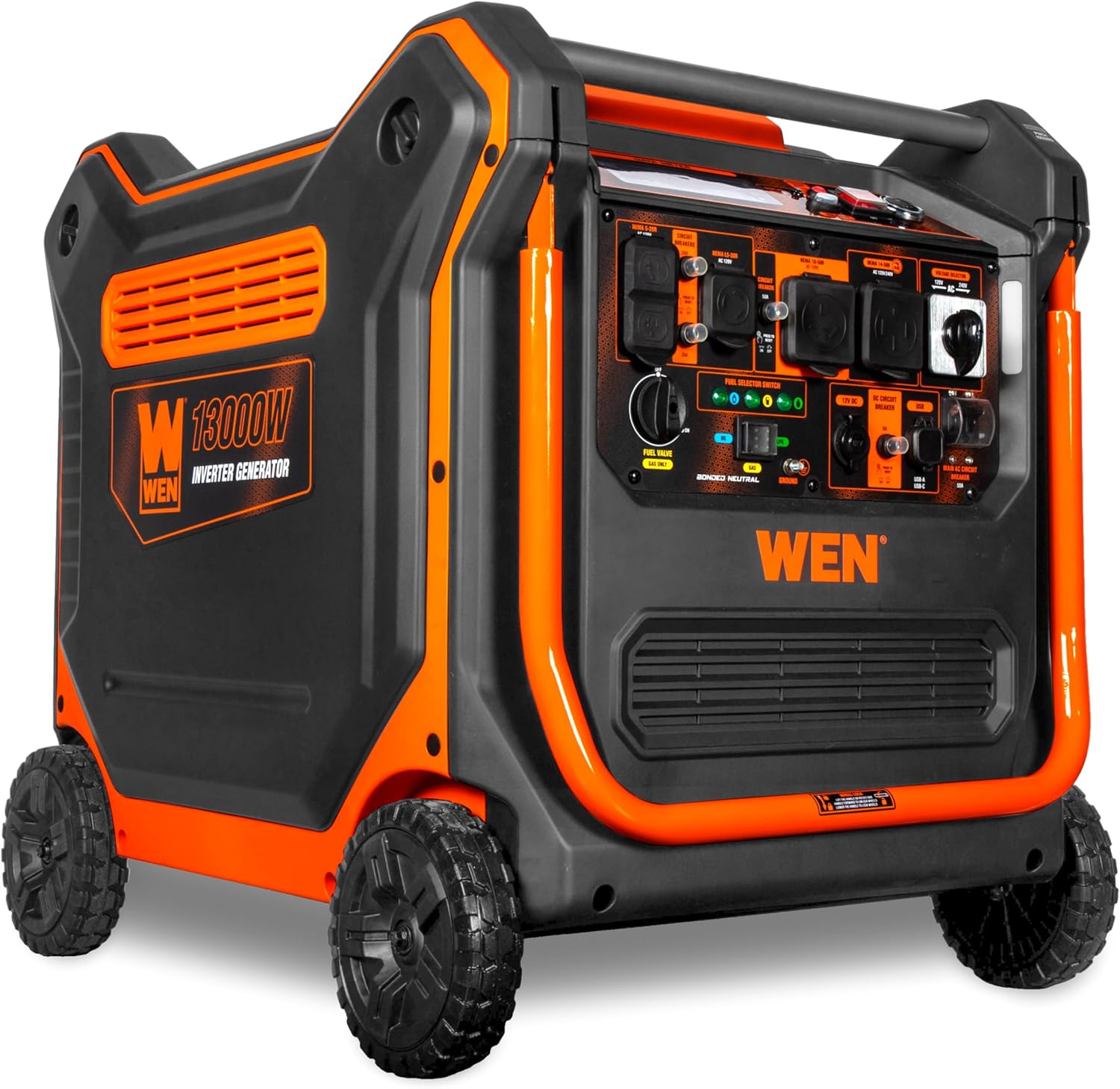
The WEN TF1300iX is a premium tri-fuel inverter generator designed for homeowners, small business operators, and outdoor enthusiasts who need reliable backup power with maximum flexibility. This 13,000-watt powerhouse runs on gasoline, propane, or natural gas, allowing users to select the most practical fuel source for their situation. Whether you're preparing for emergencies, powering job sites, or camping off-grid, this generator adapts to your needs.
The standout feature is its exceptional quiet operation at just 64 decibels at quarter load, combined with impressive power output of 10,500 running watts on gasoline. The electric start button eliminates the frustration of pull-cord starting, though a backup pull-cord is available if needed. Pure sine wave technology maintains harmonic distortion under 1.2% at full load, making it safe for laptops, smartphones, medical equipment, and other sensitive electronics. The eco-mode throttle automatically adjusts engine speed based on demand, maximizing fuel efficiency and extending runtime significantly.
Build quality is evident throughout, with a well-designed control panel featuring eight power outlets including a 120V/240V NEMA 14-50R receptacle ready for transfer switches or Level 2 EV charging. The comprehensive outlet selection includes USB ports, 12V DC output, and multiple voltage configurations. The 550cc 4-stroke engine is robust and reliable, backed by WEN's three-year limited warranty and nationwide service network. The 7.1-gallon fuel tank delivers up to 7.7 hours of half-load runtime on gasoline.
One significant limitation is the voltage selector design, which prevents simultaneous use of 120V and 240V outlets. If you need to run both voltage types concurrently, this generator won't accommodate that requirement. Additionally, at 246.9 pounds and measuring 32.3 inches long, it's a substantial machine requiring dedicated storage space. The included wheel kit and folding handle help with transport, but it's not truly portable for frequent relocation.
The WEN TF1300iX represents excellent value for serious backup power needs. It's ideal for homeowners wanting emergency preparedness, RV owners seeking reliable campground power, and small business operators needing job-site electricity. The tri-fuel capability, quiet operation, and advanced safety features including automatic CO shutdown make this generator a smart investment for long-term power security.
The tri-fuel capability is this generator's defining advantage, offering three distinct power and runtime scenarios. On gasoline, you get maximum output with 13,000 surge watts and 10,500 running watts, plus the longest runtime at 7.7 hours on half load with the 7.1-gallon tank. Gasoline is ideal for emergency backup and maximum power demands.
Propane offers a middle-ground option with 11,250 surge watts and 9,000 running watts. Using the included LPG quick-connect adapter and six-foot hose, a standard 20-pound propane tank provides approximately 3 hours of half-load runtime. Propane is cleaner burning, stores longer without degradation, and is widely available at hardware stores and gas stations.
Natural gas provides the longest-term solution for stationary installations, delivering 10,000 surge watts and 8,000 running watts. While runtime depends on your gas line pressure and flow rate, natural gas offers unlimited fuel supply when connected to your home or facility's gas line. The NG hose is sold separately, but this option eliminates fuel storage concerns entirely.
The WEN Watchdog CO Shutdown Sensor is a critical safety feature that automatically turns off the generator if carbon monoxide levels become dangerous. This is especially important for emergency backup situations where the generator might be used near living spaces. Never operate any fuel-powered generator indoors or in enclosed spaces, but this sensor provides an additional layer of protection.
Additional safety systems include automatic low-oil shutdown that prevents engine damage from inadequate lubrication, and low-fuel automatic shutdown that prevents the engine from running dry. Built-in overload protection safeguards both the generator and connected equipment from electrical damage. Indicator lights provide clear status feedback for oil level, fuel level, and overload conditions.
The fuel shutoff feature automatically engages when the engine stops, allowing remaining fuel in the carburetor to be consumed before shutdown. This prevents stagnant fuel buildup and carburetor blockages, extending the generator's lifespan and reducing maintenance requirements significantly.
How to Choose Your Emergency Generator
Fuel Type and Runtime
Your choice between gasoline, propane, natural gas, or solar power defines your emergency plan. Traditional fuel generators offer immense power for heavy loads. Dual-fuel and tri-fuel models, like the DuroMax XP11000iHT, provide critical flexibility if one fuel source becomes scarce. Solar generators, like the EF ECOFLOW DELTA Pro 3, offer silent, fume-free operation but depend on sunlight for recharging. Consider what fuel you can safely store and access during a multi-day outage.
Runtime is equally important. Check how long a generator can run at a given load on a full tank or charge. A unit that runs for 16 hours on a tank of gas provides more overnight security than one that needs refueling every 6 hours. For a broader look at options, explore our main category for emergency and storm preparedness generators.
Power Output and Capacity
First, calculate your essential power needs. Add up the starting and running watts of critical items: refrigerator, sump pump, furnace blower, lights, and medical equipment. A generator’s running wattage must meet this total. For whole-home coverage, models like the Westinghouse 18000 Peak Watt Dual Fuel Home Backup offer high output. For more targeted backup of specific circuits or devices, a portable power station with 3000-4000W, like the Jackery HomePower 3600 Plus, may be sufficient and easier to manage.
Portability and Installation
Will you need to move the generator? Wheel kits and handles are vital for heavier units. Solar generators often feature luggage-style designs with telescopic handles for easy transport. Installation complexity varies. A portable generator requires a manual transfer switch installed by an electrician for safe home backup. Many solar generators and inverter generators offer plug-and-play functionality for powering devices directly, which is simpler but may not integrate with your home’s electrical panel. For dedicated home integration, review our home backup generators category.
Noise Level and Safety Features
Noise matters, especially in neighborhoods. Inverter technology, found in models like the WEN 13,000-Watt Tri-Fuel Inverter, provides cleaner power and significantly quieter operation. Look for decibel ratings. Essential safety features include automatic low-oil shutdown, overload protection, and built-in circuit breakers. Carbon monoxide sensors that automatically shut down the unit are a critical safeguard, particularly important for any fuel-burning generator.
Smart features are becoming standard. App connectivity, available on units like the EF ECOFLOW Solar Generator 3.6KWh DELTA Pro, lets you monitor status and control settings remotely. This adds a layer of convenience and monitoring that is valuable during a stressful outage. To see how technology is enhancing preparedness, check out our guide to smart emergency generators for 2026.
Final Thoughts
Selecting the right emergency generator is an investment in your family’s resilience. For those prioritizing raw power and fuel flexibility to run a central air conditioner or well pump, the robust Westinghouse 18000 Peak Watt Dual Fuel Home Backup generator is a formidable choice. If you value silent, fume-free operation indoors and the ability to recharge via solar, the versatile and expandable EF ECOFLOW Solar Generator 3.6KWh DELTA Pro offers a modern, clean-energy solution. Whichever path you choose, ensure it aligns with your specific needs to provide reliable peace of mind when the grid goes down.
Frequently Asked Questions
What size generator do I need to power my entire house?
Powering an entire house typically requires a large standby generator. For portable options under $3000, focus on “whole-home backup” models that can connect via a transfer switch. These units, like the DuroMax XP11000iHT, can power multiple large appliances simultaneously but may not run every single circuit in a very large home. It’s more practical to calculate the essential circuits you need to keep running.
Can I run a generator indoors or in my garage?
Never run a fuel-powered generator indoors, in a garage, or in any enclosed or partially enclosed space. They produce deadly carbon monoxide fumes that can kill quickly. Always operate them outdoors, far from windows, doors, and vents. Only battery-powered solar generators, like the Jackery HomePower 3600 Plus, are safe for indoor use due to their zero-emission operation.
How long can a solar generator power my home during an outage?
It depends on the unit’s capacity (measured in watt-hours) and your power consumption. A unit like the OUKITEL 5120Wh Large Capacity Solar generator can run a refrigerator and several lights for days. For extended outages, the ability to recharge via solar panels during the day is crucial. You’ll need to manage your usage and potentially recharge over multiple days to maintain power.
What maintenance does an emergency generator require?
Fuel-powered generators need regular maintenance: fresh fuel stabilizer, oil changes, spark plug checks, and running the unit periodically to ensure it starts when needed. Solar generators require less maintenance, primarily keeping the battery charged and the solar panels clean. For all types, consult the manual and perform recommended upkeep to ensure reliability. For more general advice on emergency power, our resource on best emergency generators covers key considerations.


Write Your Review
No reviews yet. Be the first to share your experience!