

When the power goes out, your generator’s reliability hinges on one critical component: its battery. Whether you’re facing a severe storm, planning a remote camping trip, or simply preparing for the unexpected, selecting the right power source is essential. This guide focuses on modern portable power stations, the advanced batteries that now serve as versatile generators for countless applications.
We have assessed the latest models to help you find the best generator battery for your specific needs. From compact units for weekend getaways to robust systems for home backup, our review covers two standout options that excel in performance and durability. For a broader look at essential components, explore our generator accessories category.

Pros
- Exceptional portability with industry-leading weight-to-capacity ratio makes it ideal for backpackers
- LiFePO4 chemistry ensures longevity with minimal degradation over thousands of charge cycles
- Multiple charging inputs, AC outlets, and USB ports provide versatile power for diverse devices
- Fast recharge times via solar panels or AC adapter keep you powered during extended trips
- Highly rated by users for reliability, ease of use, and consistent real-world performance
Cons
- 292Wh capacity insufficient for multi-day camping with high-power appliances like refrigerators
- Solar panel sold separately, adding to total cost for off-grid solar setup
- 5-hour runtime at rated output means frequent recharging for power-intensive activities
The Jackery Explorer 300 is a portable power station designed for outdoor adventurers, campers, travelers, and emergency preparedness enthusiasts. This 292Wh solar generator combines compact design with genuine utility, offering reliable off-grid power without the weight and maintenance headaches of traditional gas generators.
The standout feature is its exceptional portability. At just 7.5 lbs, it's 17% lighter than industry competitors while maintaining robust capacity. The integrated handle and compact dimensions make it genuinely easy to pack alongside camping gear. Real-world performance is solid: users consistently report fast charging via AC adapter (approximately 3-4 hours), reliable operation across multiple devices, and seamless compatibility with Jackery solar panels for true off-grid capability.
Build quality reflects Jackery's reputation. The upgraded LiFePO4 battery chemistry delivers 4,000+ charge cycles before reaching 70% capacity, translating to 11+ years of dependable service life. The 300W rated output with 600W peak surge handles laptops, drones, cameras, and even CPAP devices without issue. Multiple connectivity options, including 2 AC outlets, 100W USB-C PD, 2 USB-A ports, and a 120W car port, ensure compatibility with virtually any device you carry.
The primary limitation is capacity. With 292Wh, it excels for single-night camping trips and emergency backup for electronics, but cannot sustain power-hungry appliances like refrigerators or air conditioning units. Additionally, solar panels are sold separately, requiring additional investment for true off-grid independence. The 5-hour runtime at rated output means frequent recharging during extended high-power usage.
Verdict: The Explorer 300 represents excellent value for its category. It's the ideal solution for weekend campers, nomads, emergency preparedness planners, and anyone seeking lightweight, reliable portable power. If you need multi-day capacity or plan to run major appliances, consider larger Jackery models instead. For the intended use case, this is a dependable, well-engineered power station that delivers consistent real-world performance.
Power Output: 300W rated output, 600W peak surge capacity
Battery Capacity: 292Wh (LiFePO4 chemistry)
Ports and Outlets: 2 AC outlets (120V), 1 USB-C PD port (100W), 2 USB-A ports (2.4A each), 1 DC car port (120W)
Charging Time: Approximately 4 hours via AC adapter
Solar Charging: 80% capacity in 2.8 hours with 100W solar panel, or 7.5 hours with 40W panel
Battery Cycles: 4,000+ cycles before reaching 70% capacity
Weight: 7.1 lbs
Dimensions: 9.1 x 5.2 x 7.8 inches
Warranty: 2-year manufacturer warranty
Model: JE-300E
Best For: Weekend camping trips, emergency backup power, travel, outdoor adventures, CPAP backup, and users prioritizing portability over high-capacity storage.
Consider Alternatives If: You need to power refrigerators or high-draw appliances for multiple days, require capacity above 300Wh, or plan to run air conditioning units during extended off-grid periods.
Solar Panel Pairing: Pair with Jackery's 100W SolarSaga panel for optimal off-grid performance and fastest recharge times. The 40W panel works for maintenance charging but requires longer recharge periods.
Optimal Use Cases: Single-night camping, emergency preparedness kits, travel backup power, drone and camera charging on location, CPAP support during power outages, and nomadic lifestyle power needs.
Maintenance: LiFePO4 chemistry requires minimal maintenance. Store in a cool, dry location and recharge periodically if unused for extended periods to maintain battery health.
Pros
- Exceptional runtime verified by real users who powered homes through multi-day outages
- Compact and lightweight design makes it genuinely portable despite 2kWh capacity
- Industry-leading 10,000-cycle battery life translates to 15 years of daily use
- Quiet operation in Silent Mode, ideal for home office and living spaces
- Multiple charging options provide flexibility for any situation
Cons
- No 12V DC port limits compatibility with some car-based accessories and devices
- Fan noise increases during fast charging in hot environments, though Silent Mode mitigates this
- 400W solar input is modest compared to larger systems, extending recharge times
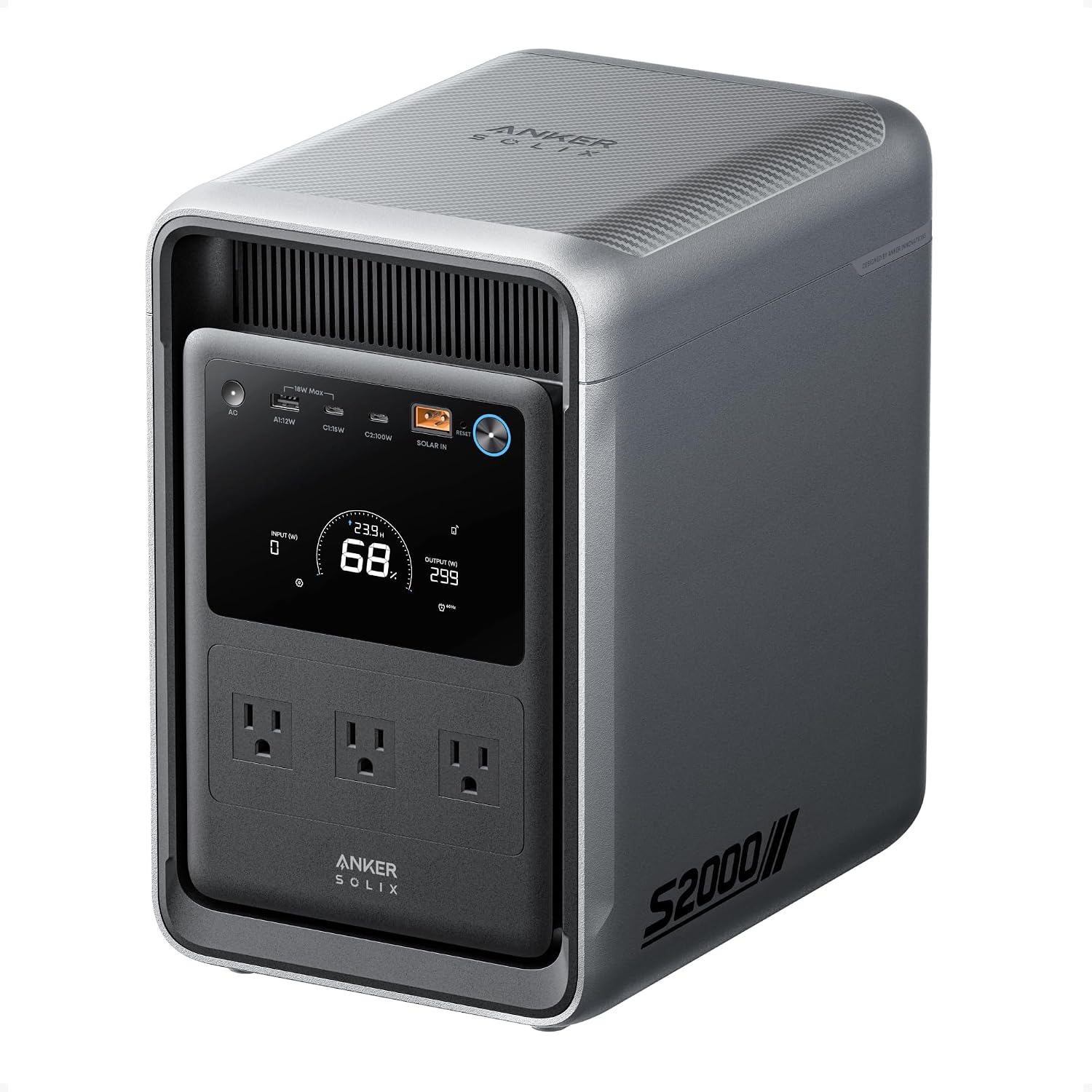
The Anker SOLIX S2000 is a 2,010Wh portable power station designed for homeowners and emergency preparedness enthusiasts who need reliable backup power without sacrificing portability. This unit bridges the gap between compact power banks and bulky home generators, offering genuine home backup capability in a form factor that can move between rooms or be stored discretely.
What sets the S2000 apart is its exceptional fridge runtime. Lab testing confirms 35-hour operation on a standard refrigerator, which translates to nearly 1.5 days of continuous power for your most critical appliance. Real-world reviews confirm users successfully powered homes through multi-day outages, with the unit maintaining quiet operation even during extended use. The 1,500W continuous output and 3,000W peak power handle essential appliances including window AC units, without the noise and maintenance of traditional generators.
The build quality reflects Anker's reputation for durability. The LiFePO4 battery chemistry supports 10,000 charge cycles to 60% capacity, equivalent to 15 years of daily use. The compact design measures just 8.2 x 11.1 x 12.7 inches and weighs 35.7 pounds, making it 30% smaller and 25% lighter than comparable 2kWh systems. The front display clearly shows battery percentage and real-time power draw, while smart app integration enables charging schedules and Silent Mode operation.
The main limitations are the lack of a 12V DC port and modest 400W solar input capacity. Fast charging at 1,600W can generate noticeable fan noise in hot environments, though Silent Mode reduces this significantly. Additionally, recharging from 20% to 80% with a 400W solar panel takes 3-4 hours under direct sunlight, making solar supplementation slower than some larger systems.
The Anker SOLIX S2000 earns strong customer satisfaction for delivering on its promises. It's the right choice for homes needing reliable emergency power, home office UPS functionality, or extended off-grid camping. The 10ms switchover time and dual-outlet design make it particularly valuable for protecting WiFi, medical equipment, and critical devices during grid failures.
Power & Capacity: 2,010Wh total capacity, 1,500W continuous output, 3,000W peak output
Battery Technology: LiFePO4 with 314Ah cells, 10,000 charge cycles to 60% capacity, 15-year lifespan
Charging: 6 methods including AC wall outlet, solar (up to 400W), generator, alternator, and car outlet. Full charge from AC: approximately 2.5 hours at 1,200W
Ports & Outlets: 8 total outlets (AC, USB-A, USB-C), front and rear configuration, no 12V DC port
Runtime: Up to 35 hours on 700L refrigerator at standard operating conditions
Physical: 8.19 x 11.1 x 12.7 inches, 35.7 pounds, Black finish
Smart Features: WiFi-enabled app control, real-time monitoring, charging schedules, Silent Mode
Warranty: 5-year manufacturer warranty
Who Should Buy: Homeowners prioritizing emergency power for essential appliances, home office users needing UPS protection, campers seeking portable solar charging capability, and anyone wanting backup power without generator maintenance and fuel costs.
Best Use Cases: Primary backup for power outages, home office UPS with 10ms switchover, extended fridge/freezer protection, camping and RV trips, medical equipment backup, and off-grid cabin support.
Consider Alternatives If: You need 12V DC charging for automotive devices, require faster solar recharging (consider 600W+ solar input models), or need capacity beyond 2kWh for extended multi-appliance operation.
Runtime Estimation: Check your refrigerator's Energy Guide label for daily consumption in kWh. Use this formula: (2.0 kWh x 0.9 efficiency) ÷ your daily consumption = runtime in days. Most refrigerators consume 0.5-1.5 kWh daily, yielding 1-3.6 days of operation.
Maximizing Performance: Enable Silent Mode in the app to reduce charging noise. Update firmware regularly for optimal efficiency. Keep ambient temperature below 77°F for best battery performance. Pair with a 400W solar panel for true off-grid capability and faster recharging during daylight hours.
Buying Guide: Key Factors for Your Generator Battery
Capacity and Runtime
Capacity, measured in watt-hours (Wh), determines how long your battery can power devices. A higher Wh rating means longer runtime for essentials like lights, phones, or medical equipment.
Consider your primary use case. A smaller capacity unit is perfect for charging gadgets on a short trip. A larger capacity system can keep a refrigerator running overnight during an outage. Always match the capacity to your most critical power needs.
Battery Chemistry and Lifespan
The battery’s internal chemistry dictates its longevity and safety. Lithium Iron Phosphate (LiFePO4) batteries are now the gold standard for generator batteries due to their exceptional cycle life and stability.
Models with LiFePO4 chemistry can withstand thousands of charge cycles, offering a service life measured in years, not seasons. This makes them a more sustainable and cost-effective choice over time compared to older battery types. For related power solutions, see our guide on solar generators and power stations.
Output Power and Port Options
Output power, measured in watts, defines what you can plug in. Continuous output must meet or exceed the wattage requirement of your appliance. Peak surge power is crucial for starting motors in tools or refrigerators.
Review the types and number of ports. Look for a mix of AC outlets, USB-C PD for fast-charging laptops, and standard USB-A ports. A versatile selection ensures you can power everything from a CPAP machine to a drone without extra adapters.
Recharging Methods and Speed
A great generator battery offers multiple recharge paths. Solar input capability is vital for off-grid scenarios and long-term emergencies. Fast AC wall charging gets you powered up quickly between uses.
Evaluate the maximum solar input wattage and the estimated charge times. A unit that supports simultaneous AC and solar charging provides the ultimate flexibility for maintaining power in any situation. Proper fuel management for traditional generators is also key, as covered in our article on choosing a reliable generator fuel stabilizer.
Final Thoughts
Selecting the best generator battery ultimately depends on balancing capacity, portability, and your specific power requirements. For lightweight, everyday adventures and short-term backup, the Jackery Explorer 300 Portable Power Station,292Wh is an excellent, easy-to-carry choice. For serious home backup, longer outages, and powering major appliances, the Anker SOLIX S2000 Portable Power Station, 2,010Wh offers exceptional runtime and robust output, making it a reliable cornerstone for any preparedness plan. Both represent the forefront of modern, clean battery power for generators.
Frequently Asked Questions
What is the difference between a generator battery and a portable power station?
A traditional generator battery is usually a 12V lead-acid battery designed solely to start a gas or diesel generator’s engine. A modern portable power station is an all-in-one unit with a high-capacity lithium battery, built-in inverter, and multiple outlets. It acts as a silent, emission-free generator itself, powering devices directly without needing a separate engine. For more on traditional home systems, visit our home standby generators page.
How long can a portable power station run a refrigerator?
Runtime varies significantly based on the power station’s capacity and the fridge’s energy consumption. A unit with a 2,000Wh capacity can typically run a modern, efficient refrigerator for 24 to 35 hours. Always check your appliance’s wattage rating and calculate expected runtime based on the battery’s usable capacity.
Can I use a portable power station as a UPS for my computer?
Yes, but only if the power station features an Uninterruptible Power Supply (UPS) function with a switchover time of less than 20 milliseconds. This near-instantaneous switch prevents your computer from shutting down during a blackout. Many advanced models now include this essential feature for protecting home office equipment.
Are lithium power stations safe to use indoors?
Portable power stations using LiFePO4 (LFP) battery chemistry are generally confirmed as safe for indoor use. They are inherently more stable and less prone to overheating than other lithium-ion types. They produce no fumes, making them ideal for basements, garages, or living areas during a power outage, unlike fuel-powered generators. For information on quiet, clean power alternatives, see our inverter generators resource.





Write Your Review
No reviews yet. Be the first to share your experience!