

When the lights flicker and go out, or you’re miles from the nearest power outlet, having a reliable energy source is not just convenient, it’s essential. Portable solar generators under 2000 watts offer a powerful, clean, and quiet solution for everything from keeping your refrigerator running during a blackout to powering your campsite amenities. This guide is crafted for homeowners seeking dependable backup power and outdoor enthusiasts who need off-grid energy without the noise and fumes of traditional gas generators.
We have assessed the latest models on the market, focusing on real-world performance, expandability, and ease of use. You will find a detailed comparison of five leading options, each balancing capacity, output, and portability to fit different scenarios. For those considering a versatile power source, our guide on the best portable power stations under 2000 watts offers additional context on battery-only solutions.

Pros
- Silent operation and zero emissions make it neighbor-friendly and suitable for any environment
- Lightweight and portable design allows even elderly users to relocate it easily when needed
- Expandable architecture lets you grow capacity as your backup power needs increase over time
- Smart energy management with Priority Routing ensures critical home systems stay powered during blackouts
- Exceptional durability with LFP battery technology rated for 6000+ cycles, outlasting most competitors
Cons
- Higher upfront cost compared to traditional gas generators, though long-term savings offset this through no fuel or maintenance
- 2400W continuous output may require load management for homes with high-demand appliances like central AC units
- Requires sunny conditions for optimal solar panel charging, making it less effective in cloudy climates without grid backup
The Jackery HomePower 2000 Plus v2 is a portable battery backup system designed for homeowners, cabin owners, and RV enthusiasts seeking reliable emergency power without the noise and hassle of traditional generators. With a 2048Wh capacity expandable to 12kWh, it bridges the gap between portable power banks and full home backup systems, making it ideal for moderate blackouts and extended off-grid scenarios.
The standout feature is its smart Priority Routing system, which automatically manages power distribution to keep essential circuits running during emergencies. Combined with 2400W output and the included 2x200W solar panels, this system provides genuine energy independence for critical home functions. Real-world users consistently praise its silent operation and ease of use, with one reviewer noting it's small enough to stay out of the way yet light enough for seniors to move.
Build quality is exceptional thanks to LFP battery technology rated for 6000+ cycles, translating to approximately 16 years of reliable service. The 40.6-pound weight represents a significant achievement in the expandable power station category, being 34% lighter than the previous generation. The compact 14.37 x 10.24 x 10.73-inch dimensions fit easily in most home spaces without requiring dedicated installation infrastructure.
The primary limitation is the 2400W continuous output, which may require load management if you're powering multiple high-demand appliances simultaneously. Additionally, solar charging efficiency depends on weather conditions and sunlight availability, making grid-tied backup or additional panels beneficial in cloudy regions. The initial investment is higher than traditional generators, though eliminated fuel costs and zero maintenance quickly justify the expense.
The Jackery HomePower 2000 Plus v2 delivers genuine peace of mind for homeowners prioritizing reliability, portability, and environmental responsibility. Its expandable architecture, intelligent power management, and proven durability make it an outstanding choice for anyone serious about backup power solutions.
Power Output: 2400W continuous, 2200W rated output
Battery Capacity: 2048Wh base unit, expandable to 12kWh
Battery Type: LFP (Lithium Iron Phosphate) with 6000+ cycle rating
Input Voltage: 120V AC
USB-C Output: 140W with Apple AVS Protocol support
Weight: 40.6 pounds
Dimensions: 14.37 inches L x 10.24 inches W x 10.73 inches H
Included Components: HomePower 2000 Plus v2 unit, 2x200W solar panels
Recommended Use: Residential, RV, emergency backup
Special Features: Easy installation, smart energy management, Priority Routing, portable design
Who Should Buy This: Homeowners in areas with frequent power outages, cabin owners seeking off-grid power, RV enthusiasts, and anyone wanting silent, reliable backup power without fuel or emissions. It's particularly suitable for those who value portability and environmental responsibility.
Who Might Want to Consider Alternatives: Homes requiring sustained 5000W+ output for multiple large appliances, locations with minimal sunlight for solar charging, or buyers with strict budget constraints who can tolerate noise and fuel-based generators.
Key Considerations: Calculate your essential circuit power needs to ensure 2400W output meets your requirements. Assess your location's average sunlight for solar charging efficiency. Consider future expandability if you anticipate growing backup power needs. Verify your home's electrical panel compatibility with the Priority Routing system before purchase.
Value Assessment: While the initial investment exceeds traditional generators, the elimination of fuel, maintenance, and noise pollution, combined with 16-year durability, provides exceptional long-term value. The expandable architecture protects your investment as energy needs evolve.

Pros
- Exceptional charging speed with 43-minute 0-80% charge time using dual input technology
- Industry-leading battery longevity with 3000 full cycles and LFP chemistry for reliability
- Comprehensive outlet variety with 15 ports accommodates virtually any household device
- Genuinely portable solar panel with rugged weatherproof construction and compact design
- Intelligent app integration for peak-rate avoidance and energy optimization
Cons
- Requires investment in additional 400W solar panel to achieve fastest 2.6-hour charging time
- 23 kg weight, while manageable, adds bulk for ultralight camping or backpacking scenarios
The EcoFlow DELTA 2 Max is a premium portable power station designed for homeowners experiencing power outages, outdoor adventurers, and eco-conscious consumers seeking solar-powered energy independence. With 2048Wh of capacity and dual charging inputs reaching 2400W combined, this unit bridges the gap between portable backup power and serious residential energy storage.
The standout feature is undoubtedly the dual-charging technology enabling 0-80% charge in just 43 minutes via combined solar and AC input, or 1.1 hours on AC alone. The included 400W solar panel with 23% conversion efficiency charges the unit fully in 5.1 hours solo, or 2.6 hours when paired with a second panel. Real-world performance shows the unit reliably powers household appliances, with 2400W continuous output and X-Boost mode supporting up to 3400W for high-demand devices like air compressors or power tools.
Build quality is impressive across the board. The LiFePO4 battery chemistry provides 3000 full charging cycles before dropping to 80% capacity, translating to 10+ years of daily use. The included solar panel weighs just 35.3 lbs with IP68 weatherproofing and a foldable design that fits most vehicle trunks. The 15 outlet variety accommodates virtually any device combination, and the smart app allows users to optimize charging schedules and monitor battery health continuously.
Primary drawbacks include the substantial $1549 investment and the need for a second solar panel to unlock the fastest charging speeds. Additionally, at 23 kg, the power station itself isn't ultralight for backpacking, though it remains portable for vehicle-based camping or home backup scenarios.
The EcoFlow DELTA 2 Max delivers exceptional value for serious users needing reliable, long-lasting solar power storage. The combination of rapid charging, industry-leading battery longevity, comprehensive outlet options, and smart controls makes this an excellent choice for both emergency home backup and sustainable outdoor power needs.
Battery Technology: LiFePO4 (Lithium Iron Phosphate)
Capacity: 2048Wh
Continuous Output: 2400W (expandable to 3400W with X-Boost)
Number of Outlets: 15 ports
Battery Cycles: 3000 cycles at 100% depth until 80% capacity retention
Charging Time (AC only): 1.1 hours to 80%
Charging Time (Dual AC+Solar): 43 minutes to 80%
Solar Panel Output: 400W included
Solar Conversion Efficiency: Up to 23%
Solar Charging Time (Single Panel): 5.1 hours
Solar Charging Time (Dual Panels): 2.6 hours
Solar Panel Weight: 35.3 lbs
Solar Panel Rating: IP68 weatherproof
Power Station Weight: 23 kg
Input Voltage: 120 volts
Warranty: 5-year extended service
Recommended Uses: Camping, residential backup power, outdoor events
Who Should Buy This: Homeowners in areas prone to power outages, outdoor enthusiasts seeking multi-day camping power, small business owners needing backup power, and eco-conscious consumers wanting solar energy independence. The DELTA 2 Max excels for users who value charging speed, battery longevity, and comprehensive device compatibility.
Who Might Want to Look Elsewhere: Budget buyers should consider entry-level models under $1000. Ultralight backpackers may prefer smaller, lighter units. Users needing 10,000+ Wh capacity should explore larger stationary systems.
Key Considerations: Evaluate your typical power needs by calculating wattage of devices you'll run simultaneously. The 2400W output handles most household appliances but not simultaneous high-draw items like water heaters or central AC. Consider purchasing a second 400W solar panel upfront if you plan frequent solar charging, as this unlocks the 2.6-hour full charge capability. The smart app is essential for optimizing charging during off-peak hours and monitoring battery health over time.
Long-Term Value: The LiFePO4 chemistry and 3000-cycle rating mean this unit will outlast competitors using standard lithium batteries by 6+ years. Factor this durability into the cost-per-year calculation, making it competitive despite the premium price. The 5-year warranty provides additional peace of mind for a multi-year investment.
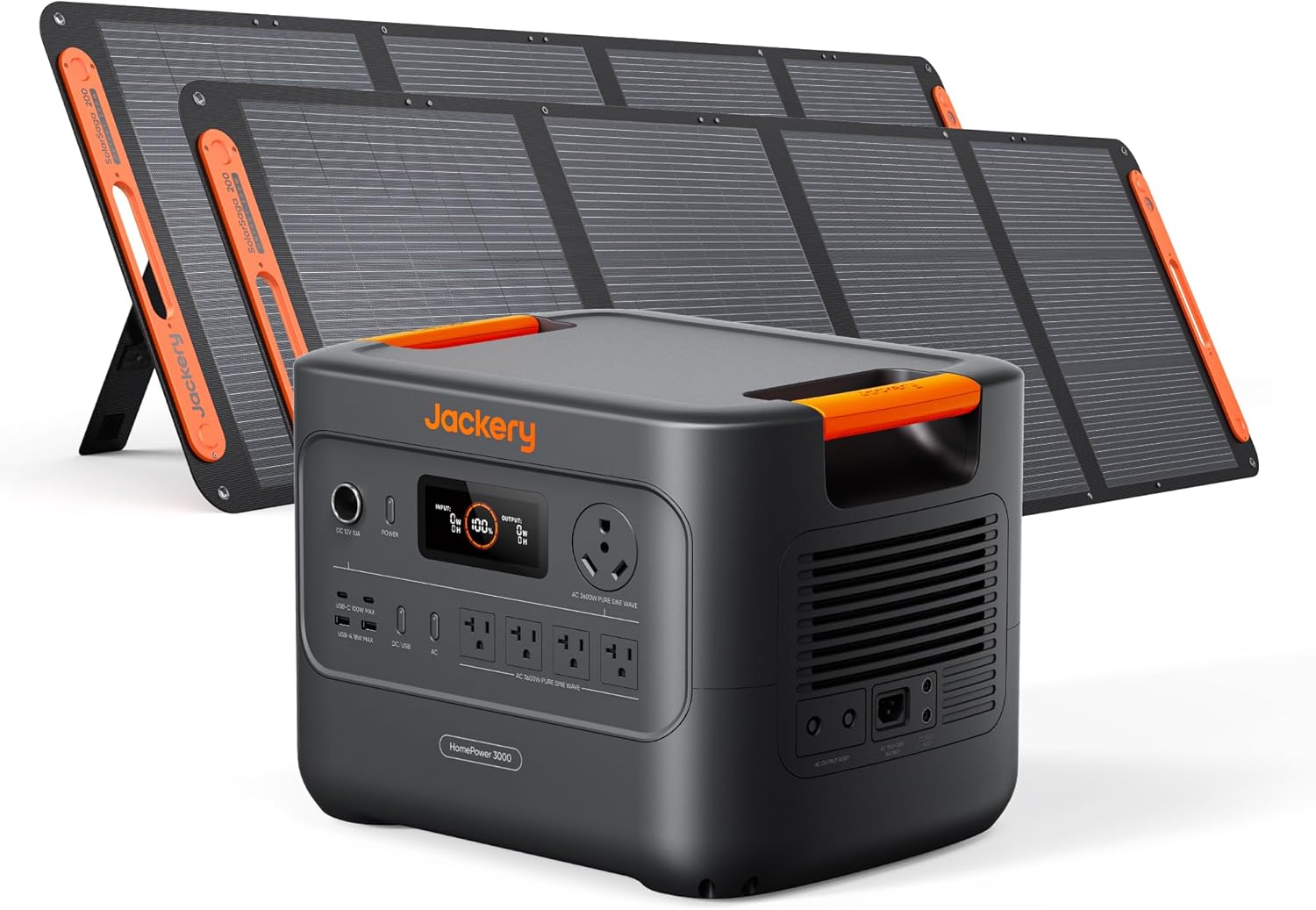
Pros
- Exceptional UPS performance with ≤20ms switching keeps medical devices, security systems, and pet feeders running uninterrupted
- Fastest charging in its class: reaches 80% capacity in 9 hours with included solar panels
- Industry-leading battery longevity with 4000 cycles and ChargeShield 2.0 AI technology for extended lifespan
- Compact design with honeycomb reinforcement provides maximum durability without bulk
- Multiple charging ports (dual 100W USB-C, USB-A, DC, TT-30 RV outlet) accommodate all device types
Cons
- Solar panels ship separately, requiring additional setup time and coordination
- Limited real-world user reviews available at launch, making it harder to verify long-term reliability claims
The Jackery HomePower 3000 is a next-generation portable power station designed for homeowners, preppers, and RV owners who demand reliable backup power without the noise and emissions of gas generators. With 3072Wh capacity and 3600W continuous output, it powers essential household items like refrigerators, fans, lights, and medical equipment for extended periods during outages, storms, or emergencies.
What sets this unit apart is its lightning-fast UPS functionality, switching to battery power in under 20 milliseconds. This means devices like security cameras, medical refrigerators, and video calls never experience interruption. The included dual 200W solar panels enable true energy independence, reaching 80% charge in just 9 hours of sunlight. Hybrid charging via AC and DC cuts recharge time to 1.7 hours, making it practical for frequent use.
Build quality impresses with its LiFePO4 battery technology, ChargeShield 2.0 AI charging optimization, and honeycomb reinforced shell. The unit weighs only 59.5 pounds and measures 16.4 x 12.8 x 12 inches, making it surprisingly portable for its capacity. The integrated design eliminates separate components, enhancing both safety and ease of transport compared to traditional power stations.
The main consideration is its premium $1799 price tag, which reflects the advanced technology and included solar panels. Additionally, solar panels arrive separately from the main unit, requiring coordination during delivery. For those seeking the fastest charging, best UPS performance, and most compact 3kWh solution available, these trade-offs are worthwhile investments.
Verdict: The HomePower 3000 represents the cutting edge of portable power technology, delivering exceptional performance for home backup and RV use. Its combination of speed, reliability, and expandability makes it a smart choice for anyone serious about emergency preparedness or off-grid living.
Battery and Power Output
Capacity: 3072Wh with 30 amp-hours
Battery Type: LiFePO4 (Lithium Iron Phosphate)
Continuous Output: 3600W at 120V AC
Surge Output: 7200W
Battery Cycles: 4000 cycles with 70% capacity retention
Charging Performance
AC Charge Time (0-100%): 2.2 hours
Hybrid AC+DC Charge Time: 1.7 hours
Solar Charging (with 2x200W panels): 9 hours to 80%
Alternative Charging: 12V car charger, gas generator compatible
Connectivity and Ports
Outlets: 4 AC outlets (120V)
USB-C: 2x 100W Power Delivery ports
USB-A: Standard ports
DC Ports: Multiple options
RV Port: Built-in TT-30 connector
Total Ports: Multiple connection types for simultaneous charging
Physical Specifications
Weight: 59.5 pounds
Dimensions: 16.4 x 12.8 x 12 inches
Design: CTB technology with honeycomb-style reinforced shell
Color: Black
Warranty: 5-year manufacturer coverage
UPS and Safety
UPS Switching Time: Less than 20 milliseconds
UPS Certification: UL-certified
Charge Management: ChargeShield 2.0 with AI algorithms
Is This Right for You?
The HomePower 3000 excels for homeowners seeking uninterrupted power during outages, especially those with medical equipment, security systems, or refrigeration needs. RV enthusiasts benefit from the built-in TT-30 port and included solar panels for extended off-grid camping. Preppers and those in storm-prone regions get the fastest UPS switching available, ensuring critical devices never lose power.
Real-World Runtime Examples
Refrigerator (520W): Runs 5-6 hours continuously
Laptop (80W): Charges 36 times from full battery
Microwave (960-1160W): Runs for 2 hours
WiFi Router + Lights + Fan: Supports 12-15 hours of typical household use
These runtimes assume continuous use and vary based on actual device power draw.
Comparison Considerations
The HomePower 3000 sits between the Explorer 2000 (2042Wh, lower capacity) and HomePower 3600 Plus (3584Wh, slightly higher capacity). Choose the 3000 if you want the most compact 3kWh option. The included solar panels add significant value compared to purchasing panels separately, making the bundle price more competitive than standalone power stations.
Setup and Installation
The unit arrives ready to use with minimal setup required. Simply unbox, charge via AC outlet or solar panels, and connect devices to appropriate ports. Solar panels require basic mounting or positioning toward the sun. The accompanying app enables remote monitoring and optimization of charging cycles.

Pros
- Exceptional runtime: powers refrigerators for 6+ hours, laptops 43+ times per charge
- Fastest charging in class: reaches full capacity in just 2 hours with hybrid AC+Solar option
- Industry-leading durability with ceramic membrane battery cells tested at 302°F and extreme cold operation
- Genuinely portable despite 77.2 lbs weight, with automotive-grade wheels and telescopic handle
- Proven reliability with multiple 5-star user reviews from real emergency and camping situations
Cons
- Solar panels sold separately, requiring additional expense for true off-grid capability
- Heavier than some competing models, though lighter than comparable 3.6kWh units
The Jackery HomePower 3600 Plus is a mid-capacity portable power station designed for homeowners, RV enthusiasts, and small business operators who need serious backup power without industrial-scale equipment. With 3584Wh capacity and 3600W continuous output, it bridges the gap between emergency backup and extended off-grid living. This unit is perfect for those experiencing frequent power outages, planning extended camping trips, or building a resilient home energy system.
The standout feature is its versatility in charging and expandability. You can recharge from empty in just 2 hours using the hybrid AC+Solar method, 2.5 hours with wall power alone, or 4 hours with solar panels. The expandable architecture lets you chain multiple units to reach 21kWh per station or 43kWh total, giving you genuine flexibility as your needs grow. Real-world testing shows it powers a 520W refrigerator for 6 hours, runs a microwave for 2.6 hours, or charges a laptop 43 times before depleting. This translates to genuine emergency capability rather than just phone charging.
Build quality is impressive. The LFP battery uses high-temp resistant ceramic membrane cells tested at 302°F, preventing thermal runaway and enabling operation in minus-4°F conditions. With 6,000 charge cycles and a 10-year manufacturer warranty, this unit is built to outlast most competitors. The industrial design feels solid, though at 77.2 pounds it requires some effort to move, though the luggage-style wheels and telescopic handle make it surprisingly portable for its capacity.
The main drawback is cost. At $1,869, this represents a significant investment, and you'll need to buy solar panels separately if you want true off-grid charging capability. The learning curve is minimal thanks to the app-controlled wattage management and straightforward plug-and-play design, but the upfront expense means this is best suited for serious users rather than casual backup seekers.
Verdict: The HomePower 3600 Plus delivers exceptional real-world performance, proven durability, and genuine flexibility for homeowners and adventurers who need reliable power beyond occasional emergencies. If budget allows and you value long-term reliability, this is one of the most practical mid-range power stations available today.
Capacity and Power: 3584Wh LFP battery, 3600W continuous AC output, 7200W peak in parallel configuration, dual 120V and 240V output capability.
Charging Options: AC charging in 2.5 hours, solar charging in 4 hours, hybrid AC+Solar in 2 hours, or gas generator charging in 2.5 hours. App-controlled wattage management for wall outlet charging.
Physical Specs: Dimensions 15.2 x 12.2 x 19.3 inches, weight 77.2 pounds, automotive-grade CTB technology, luggage-style design with telescopic handle and rolling wheels.
Durability: 6,000 charge cycles, 10-year lifespan, ceramic membrane LFP cells tested at 302°F, operates in temperatures from minus-4°F to 113°F, 5-year manufacturer warranty.
Expandability: Capacity expandable to 21kWh per unit or 43kWh with multiple units connected in parallel.
Best For: Homeowners with frequent power outages, RV and camping enthusiasts, small business operators needing backup power, and preppers building resilient energy systems. Also ideal for those in hurricane or severe weather zones.
Not Ideal For: Casual users who only need phone charging, renters with limited space, or budget-conscious buyers looking for under $1,000 solutions. Those wanting immediate solar capability without additional purchase.
Key Considerations: Budget for solar panels separately if you plan off-grid charging. Calculate your actual power needs: a 520W refrigerator runs 6 hours, 960W microwave runs 2.6 hours, 80W laptop charges 43 times. Consider expandability needs now to avoid future regrets. The app control is convenient but requires smartphone access.
Comparison Context: This unit occupies the premium mid-tier segment. The HomePower 3000 ($1,399) offers similar wattage but less capacity. The Explorer 5000 Plus ($899 less) provides higher output but costs more. Choose based on capacity needs and budget constraints rather than wattage alone.

Pros
- Exceptional expandability lets you triple your power capacity by connecting additional battery units
- Industry-leading 10-year battery lifespan and 4000 charge cycles outlast competing portable power stations
- Comprehensive 15-port ecosystem eliminates the need for adapters or secondary charging hubs
- Dual 1500W AC and 2000W solar input enables fastest possible recharge times in real-world conditions
- Bluetooth app monitoring gives you remote control and detailed battery diagnostics from your smartphone
Cons
- 92-pound weight and 21.6 x 12.6 x 18.5 inch dimensions make it less portable than compact competitors
- No customer reviews available yet, so long-term reliability and real-world performance remain unverified
The ABOK Ark3600 is a premium portable power station designed for homeowners, RV owners, and off-grid enthusiasts who demand reliable, scalable backup power. With its 3600W continuous output and expandable 3840Wh to 11520Wh capacity, this unit bridges the gap between portable convenience and home-grade power solutions. It's built for those who refuse to compromise during emergencies or extended time away from grid power.
Performance standouts include the remarkably fast 1.29-hour recharge using combined AC and solar input, making it practical for rapid turnaround scenarios. The 15 output ports represent thoughtful engineering, covering AC outlets, multiple USB-C PD ports up to 100W, USB-A quick charge, and specialized DC connections. This eliminates adapter clutter and lets you power phones, laptops, power tools, and appliances without juggling cables. The dual charging capability via AC, solar panels, or car input ensures you're never stuck without a recharge option.
Build quality reflects the premium positioning. The EV-grade LiFePO4 battery chemistry delivers 4000+ charge cycles and an impressive 10-year lifespan, substantially outlasting lithium-ion alternatives. Advanced protection circuits guard against overload, overheating, overcharging, and short circuits. The Bluetooth app integration adds practical value, allowing remote monitoring and optimization of power consumption from your phone. The included 3x200W solar panels and comprehensive cable kit mean you're ready to deploy immediately out of the box.
Drawbacks center on practicality and verification. At 92 pounds and measuring over 18 inches tall, this isn't a grab-and-go solution like compact 500Wh units. The $1699 investment is substantial, and the complete lack of customer reviews means real-world reliability remains unproven. Additionally, the expandability feature requires purchasing additional battery modules separately, adding to total system cost.
Verdict: The ABOK Ark3600 excels for serious backup power needs where reliability, expandability, and multi-device support matter more than portability or budget constraints. It's an excellent choice for home emergency preparedness, RV living, or off-grid applications where you can position it permanently and leverage its exceptional battery lifespan.
Power Output: 3600W continuous, 4500W starting wattage
Battery Capacity: 3840Wh base, expandable to 11520Wh with additional modules
Battery Type: EV-grade LiFePO4 with 4000+ charge cycles, 10-year lifespan
Charging Options: AC (1500W input), Solar (2000W PV input), Car input. Combined AC and solar recharge in 1.29 hours, AC alone in approximately 3 hours
Output Ports: 1x AC 30A, 4x AC 20A, 2x USB-A QC3.0, 3x USB-C PD 20W, 1x USB-C PD 100W, 2x DC5521 (12V/3A), 1x XT60 (12V/25A), 1x 12V cigarette lighter (12V/10A)
Dimensions: 21.6 inches L x 12.6 inches W x 18.5 inches H
Weight: 92 pounds
Warranty: 2 years standard plus 3 years extended coverage
Included Accessories: 3x 200W solar panels, AC charger cable, MC4 to XT90 cable, cigarette lighter cable, user manual
Is this right for you? The Ark3600 suits homeowners installing solar backup systems, RV full-timers needing reliable power infrastructure, and off-grid property owners. It's overkill for casual camping trips but ideal for permanent or semi-permanent installations where expandability and long battery life justify the investment.
Power requirements: Calculate your essential loads during outages. A refrigerator (600W), Wi-Fi router (15W), lights (100W), and laptop charger (65W) total roughly 780W continuous. The Ark3600 handles this easily with room for simultaneous microwave use (1000-1500W). Use the 15 ports to avoid daisy-chaining power strips.
Solar integration: The included 3x 200W panels (600W total) recharge the battery in approximately 6-7 hours under full sun. Combined with AC charging during grid availability, you achieve the advertised 1.29-hour recharge. For permanent installations, consider additional solar panels to maintain charge during extended cloudy periods.
Expandability strategy: Start with the base 3840Wh unit for most household needs. Purchase additional battery modules only if you later need to power larger appliances simultaneously or extend runtime during multi-day outages. This staged approach spreads costs over time.
Federal tax credits: Verify eligibility for the 30% Residential Clean Energy Credit with your utility provider. This credit applies to qualified solar electric property costs, potentially reducing your net investment significantly. Requirements vary by location and installation type.
How to Choose Your Portable Solar Generator
Assess Your Power Capacity and Output Needs
Start by calculating the total watt-hours your essential devices will consume. A generator’s capacity, measured in watt-hours (Wh), tells you how long it can run your gear. Its continuous output, measured in watts (W), determines what it can power at once. For reliable home backup, you need enough output to start a refrigerator’s compressor and enough capacity to run it for hours.
Look for models with a surge rating that can handle the initial spike from motors. The products reviewed here offer robust outputs suitable for major appliances. Understanding your needs within the broader category of under 3000 watts can help narrow your focus to the right power band.
Evaluate Solar Charging Speed and Compatibility
Solar charging speed is dictated by the generator’s maximum solar input in watts and the efficiency of the panels. A higher input rating allows you to connect more or larger panels for faster recharging. Check the compatibility of the included solar panels and whether the system supports simultaneous AC and solar charging for the quickest replenishment.
Consider the panel’s portability and weather resistance if you plan to use it outdoors. For expanding your system later, review our resource on the best solar panel kits for generators under 3000 watts.
Prioritize Battery Life and Long-Term Reliability
The battery chemistry is a key indicator of longevity. Lithium Iron Phosphate (LiFePO4 or LFP) batteries are the current standard for safety and cycle life, often rated for thousands of charges. A higher cycle count means the unit will retain usable capacity for many years, making it a sound long-term investment.
Features like advanced battery management systems protect against overcharging and overheating. For safe operation with any generator, proper setup is crucial, as outlined in our article on best generator grounding rods for small generators.
Consider Portability and Usability Features
Even a powerful generator is only helpful if you can move it where you need it. Look for integrated handles, wheels, and a compact form factor. User-friendly interfaces, informative displays, and companion mobile apps for remote monitoring greatly enhance the overall experience, allowing you to manage power flow effortlessly.
The number and type of output ports determine how many devices you can run simultaneously. Ensure the unit has the right mix of AC outlets, USB-C ports with Power Delivery, and DC ports for your specific devices.
Final Thoughts
Investing in a portable solar generator under 2000 watts equips you with a versatile and reliable power source for both planned adventures and unexpected emergencies. For users seeking an exceptional balance of rapid charging and smart features for home backup, the EF ECOFLOW DELTA 2 Max Solar Generator 2048Wh is a compelling choice. Meanwhile, those who prioritize maximum expandable capacity and robust output for longer outages should strongly consider the Jackery HomePower 3600 Plus Portable Power. You can explore all options in this category on our main Generators by Wattage hub to find the perfect match for your energy independence goals.
Frequently Asked Questions
What can I realistically power with a portable solar generator under 2000 watts?
These generators are capable of running essential home appliances during an outage, such as refrigerators, Wi-Fi routers, lights, fans, and medical devices like CPAP machines. They can also power tools at a job site, kitchen appliances in an RV, or charge laptops and phones for days on a camping trip. Always check the wattage requirements of your specific devices against the generator’s continuous and surge power ratings.
How long does it take to recharge a solar generator using only the sun?
Recharge time varies based on the generator’s battery capacity, the wattage of the solar panels used, and sunlight conditions. With optimal, direct sunlight, a system pairing a 2000Wh capacity unit with 400 watts of solar panels might recharge in 5 to 9 hours. Using more panels or higher-wattage panels can significantly reduce this time, as seen with models that support high solar input.
Are portable solar generators safe to use indoors?
Yes, one of their primary advantages over fuel-powered generators is that they produce zero emissions, making them completely safe for indoor use. There are no harmful fumes, carbon monoxide risks, or loud noise. You can safely operate them in your living room, garage, or tent to power devices. Always ensure proper ventilation if charging the unit indoors with AC power.
How many years should I expect a quality solar generator to last?
The lifespan is largely determined by its battery. Modern units featuring LiFePO4 batteries are commonly rated for 3000 to 6000 full charge cycles while retaining most of their original capacity. With typical use, this translates to a reliable service life of 10 years or more. Proper care, like avoiding complete discharges and storing in a moderate climate, will help maximize its longevity through 2026 and beyond.


Write Your Review
No reviews yet. Be the first to share your experience!